How to Manage 3PL Performance
You can manage 3PL performance by setting clear expectations, tracking key metrics, reviewing results, and correcting issues before they affect customers. A third-party logistics (3PL) provider handles services that directly influence your costs, operational efficiency, and customer experience. For businesses, identifying performance gaps early can help control costs, improve service quality, and keep your logistics operations on track.
At Brick Dynamics, we help businesses manage their physical operations through local warehousing, order fulfillment, logistics, and field support. Over the past three years, we’ve built a network covering more than 65 U.S. metros, with over 500 local experts supporting daily operations. Our approach prioritizes real-time visibility and hands-on execution across inventory, deliveries, installations, maintenance, and other critical operations. If you need to monitor 3PL performance more closely, contact us to build a more accountable and scalable operation.
In this article, we’ll cover the steps to manage 3PL performance, the key metrics to track, and ways to improve overall performance.
What Are the Steps to Manage 3PL Performance?
The performance of your third-party logistics provider can directly affect your business operations. You shouldn’t leave performance management entirely to your 3PL. Set clear expectations, and have a plan for addressing performance gaps. Here are the key steps you can follow to effectively manage 3PL performance.
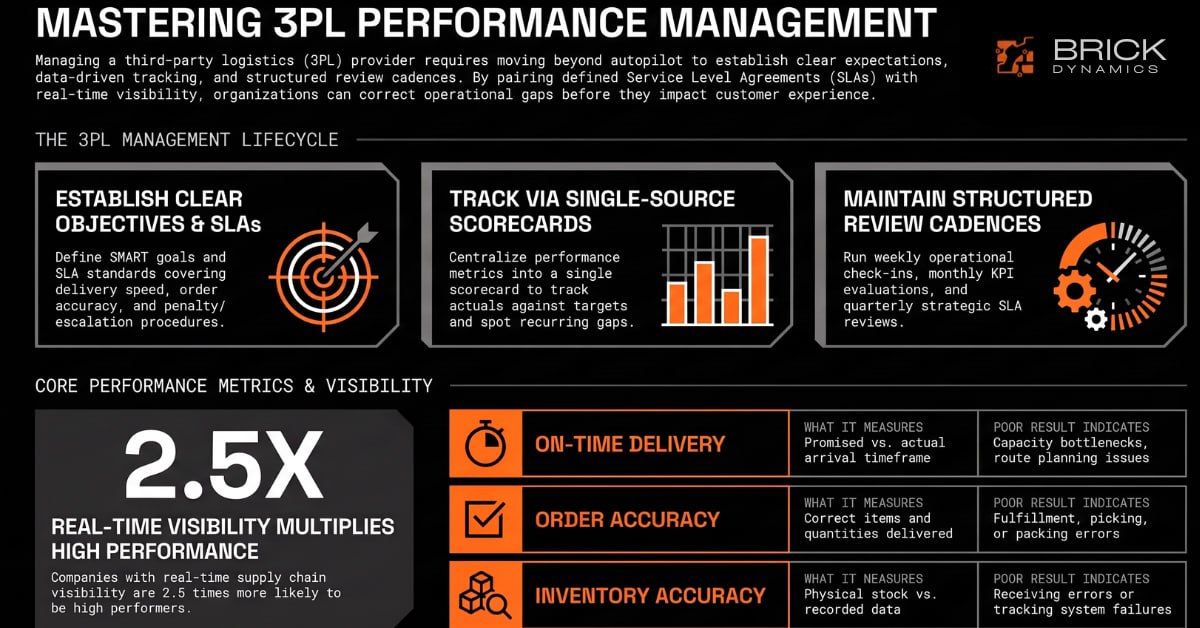
1. Define Clear Goals and Objectives
Without clear performance objectives, it’s hard to know what is working and what isn’t. Everything can move on autopilot, which can drive up operational costs and create problems within your operations. To avoid this, set specific, measurable, achievable, relevant, and time-bound (SMART) goals.
Make sure your 3PL objectives align with your current and future business goals. Set clear expectations for service quality, shipping, delivery speed, shipping accuracy, order fulfillment, inventory accuracy, and scalability. Then, establish realistic targets based on your business needs and expected order volumes. This gives you a clear way to tell whether your 3PL is meeting the standards your business needs.
2. Establish Service Level Agreements (SLAs)
Without a clear service level agreement (SLA), it becomes harder to hold your 3PL provider accountable for its performance. Your SLA should establish clear performance expectations. The SLA should define the services the 3PL will provide, along with measurable standards and targets for each one.
It should also outline reporting requirements, responsibilities, incentives, penalties, and escalation procedures where appropriate. These terms give both sides a clear understanding of what is expected and what happens when performance falls short. Use quarterly business reviews to keep 3PL capabilities aligned as your company grows or its operational needs change. These meetings also give you a set time to review the SLA and update it where necessary.
3. Define Key Performance Indicators (KPIs) and Benchmarks
You can’t manage 3PL performance if you don’t know what good performance looks like. KPIs give you a clear way to measure whether your provider is meeting the standards you agreed on. Start by setting standards based on industry benchmarks for each area that matters to your business.
These can include order accuracy, delivery accuracy, customer satisfaction, inventory accuracy, fulfillment cycle time, return processing time, and damage or loss rates. The table below shows some of the most important KPIs to track.
| KPI | What It Measures | What a Poor Result May Indicate |
|---|---|---|
| On-time Delivery | Whether orders reach customers within the promised timeframe | Delivery delays, capacity issues, or poor route planning |
| Order Accuracy | Whether customers receive the correct items and quantities | Picking, packing, or fulfillment errors |
| Inventory Accuracy | Whether inventory records match actual stock | Receiving errors, poor tracking, or inventory management issues |
| Cost Per Order | How much it costs to fulfill each order | Rising fulfillment costs or inefficient processes |
| Fulfillment Cycle Time | How long it takes to process an order from receipt to shipment | Delays in picking, packing, or order processing |
| Return Processing Time | How quickly returned products are received and processed | Poor reverse logistics or processing delays |
| Customer Satisfaction | How customers perceive the delivery and fulfillment experience | Service quality issues, delays, or recurring order problems |
The right KPIs depend on your operations, order volumes, and priorities. Once you have your benchmarks, compare your 3PL’s results against them regularly. This makes it easier to spot performance gaps before they become bigger operational problems. For example, if your benchmark is 95% on-time delivery but your 3PL consistently falls below it, it becomes clear what you need to investigate.
The same applies to rising fulfillment costs, inventory discrepancies, or slower return processing. Tracking these results gives you a better understanding of where your 3PL is performing well and where it needs to improve.
4. Build a 3PL Performance Scorecard
Keeping track of several KPIs can become difficult when the data is spread across different reports. A 3PL performance scorecard brings your key performance data into one place. This gives you a clearer view of how your provider is performing against the targets you have set. Track each KPI by comparing its target with the actual results.
A scorecard also makes it easier to spot trends, performance gaps, and recurring issues over time. If a 3PL repeatedly misses a target, you can identify the problem and assign a corrective action instead of letting it continue. You can then use the scorecard during regular performance reviews to discuss results, address concerns, and track performance. This creates a consistent way to evaluate your 3PL and keep both sides accountable.

5. Monitor Performance With Real-Time Data
Waiting for a monthly report can leave you reacting only after an issue has disrupted service or damaged customer trust. Real-time data gives you a clearer view of your 3PL’s day-to-day performance. Many businesses still lack that visibility.
Gartner research found that companies with real-time supply chain visibility are 2.5 times more likely to be high performers, yet 76% of businesses still operate without full end-to-end visibility. Real-time inventory tracking makes it easier to track shipments, inventory levels, orders, and fulfillment activity as they happen. You can use GPS, RFID, warehouse management systems, and other tracking platforms.
Real-time monitoring also helps you focus on exceptions instead of checking every activity manually. For example, you can identify delayed shipments, inventory inconsistency, or fulfillment issues as they occur. This gives your team time to investigate the cause and take corrective action before the problem gets worse. With better visibility, you can make faster decisions and address performance issues before they turn into larger operational problems.
Here is how this works in practice. Brick Dynamics has supported multi-city brand activations that required inventory management, on-time shipping, and on-site setup across several markets. Centralized tracking and local teams helped keep each operation aligned from planning through completion.
Teams could monitor assets, coordinate deliveries, and manage local execution without relying on fragmented updates. As a result, brand teams could focus on the customer experience rather than chase logistics issues. This shows the value of real-time visibility. It provides more than data. It gives teams a clearer view of operations and helps them respond quickly when issues arise.

6. Conduct Regular Performance Reviews
Regular reviews help you catch smaller issues before they become recurring problems. They also give you a chance to discuss performance trends and make sure your 3PL remains aligned with your business needs. Depending on your operations, you may need weekly check-ins to discuss urgent issues, shipments, or day-to-day performance.
For a broader view, conduct monthly reviews of your KPIs and SLA performance. Then, use quarterly reviews to look at larger trends, costs, capacity, and opportunities for improvement. Make sure each review is documented, including the issues discussed, decisions made, assigned responsibilities, and follow-up actions. This gives both sides a clear record of what needs to happen and makes it easier to track whether agreed improvements are actually being made.

7. Address Performance Gaps With Corrective Action
Performance issues are easier to fix when you address them early and understand what is causing them. Identify where your 3PL’s performance falls below the agreed benchmark. Then, investigate the root cause instead of treating only the immediate symptom.
For example, repeated late deliveries could result from capacity issues, poor route planning, or delays during fulfillment. Understanding the cause helps you choose a solution that addresses the problem properly.
Once you identify the cause, agree on corrective actions with your 3PL provider. Assign responsibility and set clear deadlines for each action so everyone knows what needs to happen next. After implementation, monitor the results to see whether performance improves against the original benchmark.
If the same issue continues or remains unresolved, escalate it through the procedures outlined in your SLA. This keeps performance management systems focused on measurable improvement rather than repeated discussions about the same problem.
How Can You Improve 3PL Performance?
If you work with a 3PL partner, their performance can affect your business. When they do their job well, your operations run smoothly. But when they fall short, you may face setbacks that leave customers unhappy. So, what can you do to improve their performance?
1. Enhance Supply Chain Visibility
It’s easier to fix problems across your operations when you can see every part clearly, and most businesses can’t yet. A recent supply chain visibility survey by Tive found that 77% of decision-makers call real-time visibility a must-have, but only 25% actually have trackers in place to deliver it.
Closing that gap is what real-time tracking gives you. It improves visibility across logistics networks by monitoring inventory, shipments, deliveries, and returns as they happen.
This way, you can identify operational issues earlier and correct them before they spread across the operation. With better visibility, you can also make faster decisions and see whether your 3PL partner is meeting your expectations.
2. Build a Strong Relationship With Your 3PL Provider
Your 3PL provider cannot serve your business well if they don’t understand your specific needs. Clear communication helps your 3PL partner understand what you expect and how you will measure their performance. Use reliable communication channels and clear points of contact so you can raise concerns as they arise.
Share performance data and feedback openly, then work with your 3PL to solve problems and improve processes. Give your 3PL regular forecasts so they can plan labor and storage capacity as demand changes. Treat the relationship as an ongoing partnership, and it becomes easier to address challenges.
3. Manage Risks and Prepare for Disruptions
Another way to improve your 3PL performance is to monitor operational issues. This helps you identify potential risks before they turn into bigger problems. Look for risks across transportation, local warehousing, inventory, and fulfillment.
Have contingency plans for transportation delays, capacity shortages, and sudden demand spikes. Prepare for busy periods and market expansion so your 3PL can handle changes without disrupting your operations. For major disruptions, make sure there is a clear procedure so everyone knows what to do and who needs to act.
4. Use Automation and AI to Improve Performance
Automation can make 3PL oversight faster and more consistent. Automated systems can reduce manual work and operational errors that cost you time and money. AI and analytics can also help you spot patterns in your performance data.
You can then use these insights to anticipate delays, changes in demand, and other potential issues. But technology should not stand alone. It should connect with your physical operations and help improve how your 3PL handles the work, rather than replace the people and processes behind it.
5. Establish Benchmarks for Continuous Improvement
Just because you’re meeting your current benchmarks does not mean your 3PL performance cannot improve. As your business grows, customer expectations and order volumes change. For this reason, you may need to review those benchmarks. Compare current results with historical performance targets to spot trends and find areas that need improvement.
You can also work with your 3PL provider to set measurable improvement targets that go beyond the minimum SLA requirements. Regular performance reviews give you a chance to refine processes, update expectations, and keep looking for ways to improve.
When Should You Reevaluate a 3PL’s Performance?
When your 3PL no longer meets your business needs, it may be time to reassess the relationship. Poor performance can quickly affect your operations, so recurring failures require a documented response. A single missed target may not be a major concern. However, repeated SLA or KPI failures are difficult to overlook.
Declining delivery performance is another warning sign. Frequent inventory discrepancies, rising fulfillment costs, storage fees, or transportation expenses also deserve closer attention. When these problems keep happening, it may be time to make a change.
Customer complaints and product returns are further signs that you may need to reassess your 3PL. Communication issues also deserve attention. For example, your provider may be difficult to reach or slow to resolve problems. Review the results of any corrective actions as well. If the same issues continue after repeated efforts to fix them, a more reliable fix may be necessary.
Your business may eventually outgrow what its 3PL can handle. Your provider should be able to manage increasing order volumes, support expansion into new markets, and adjust to changing operational needs. If it cannot, it may be time to reassess the relationship. Review these factors regularly to confirm that your 3PL continues to deliver the service level your business requires.
How Can You Keep Your 3PL Performance on Track?
Strong 3PL performance begins with clear expectations. Set measurable goals, establish SLAs, and define relevant KPIs. Monitor performance regularly and use real-time visibility to identify issues early. Then review the results and take corrective action when necessary. This approach helps you hold your 3PL accountable while keeping operations running smoothly.
Managing a 3PL is not something you do once and forget about. It requires ongoing attention, especially as the market itself keeps shifting. The U.S. 3PL market reached $323.4 billion in 2025, up 5% year over year, which means more competition, more provider options, and less reason to settle for a partner that isn’t performing. Your business needs may change over time, and your provider’s performance may change as well.
Continue to monitor performance data and stay in regular contact with your provider. When issues arise, work together to resolve them. The right data can reveal inefficiencies, improve service quality, and help ensure your logistics operation is ready for future growth.
At Brick Dynamics, we help businesses improve physical operations through local warehousing, logistics, and field support, with real-time visibility into the work being done. Over the past three years, we have built a network across more than 65 U.S. metro areas, supported by over 500 local experts who help keep daily operations on track. If you need more visibility, accountability, and reliable execution from your physical operations, book a strategy call to see how we can help you.
Frequently Asked Questions
Managing 3PL performance often raises important questions. You may wonder which metrics to track, how often to review results, and how to respond when performance falls short. The following answers address common questions and help you keep your 3PL performance on track.
What Key Performance Indicators Should Be Used to Manage 3PL Performance?
The key 3PL KPIs include on-time delivery, order accuracy, inventory accuracy, customer satisfaction, and cost per order. Tracking these metrics helps you measure service quality, control costs, and identify performance gaps.
How Often Should You Review 3PL Performance?
You should review 3PL performance weekly for operational issues, monthly for KPIs and SLAs, and quarterly for broader trends and strategy. This review schedule helps you catch problems early while giving you time to assess costs, capacity, and improvement opportunities.
What Should You Do When a 3PL Misses Its SLA?
Start by identifying the root cause of the missed SLA, then agree on corrective actions with your 3PL provider and assign clear responsibilities. Monitor the results against the agreed target, and escalate the issue if performance does not improve.
How Can Technology Improve 3PL Performance Management?
Real-time tracking, data analytics, automation, and AI can give you better visibility into shipments, physical inventory, orders, and overall 3PL performance. These tools help you spot issues earlier, reduce manual errors, and make better, data-driven decisions.
What Are the Benefits of Establishing Clear SLAs With 3PL Providers?
Clear SLAs set measurable expectations for your 3PL provider and make it easier to hold them accountable for their performance. They also give you a consistent basis for reviewing results, identifying gaps, and addressing performance issues.