How 3PL Warehouses Support Omnichannel Fulfillment
3PL warehouses support omnichannel fulfillment by storing inventory, processing orders, and shipping products across multiple sales channels. When you sell through a website, store, marketplace, or app, a 3PL can take on the behind-the-scenes work of keeping orders and inventory moving. With the right partner, you can keep costs in check, ship faster, and make it easier for customers to get what they ordered.
For the past three years, Brick Dynamics has helped businesses handle warehousing, inventory, and logistics in several markets. Our network covers more than 65 metros, where 500+ local experts complete roughly 1,000 jobs a day. We bring together distributed warehousing, live inventory tracking, fulfillment, and delivery so products can stay closer to the people buying them. If you are looking for a more reliable way to run omnichannel fulfillment, contact us to help build and manage the physical operation behind it.
In this guide, we will walk through how omnichannel fulfillment works, where 3PL warehouses fit in, and how Brick Dynamics supports connected fulfillment operations.
What is Omnichannel Fulfillment?
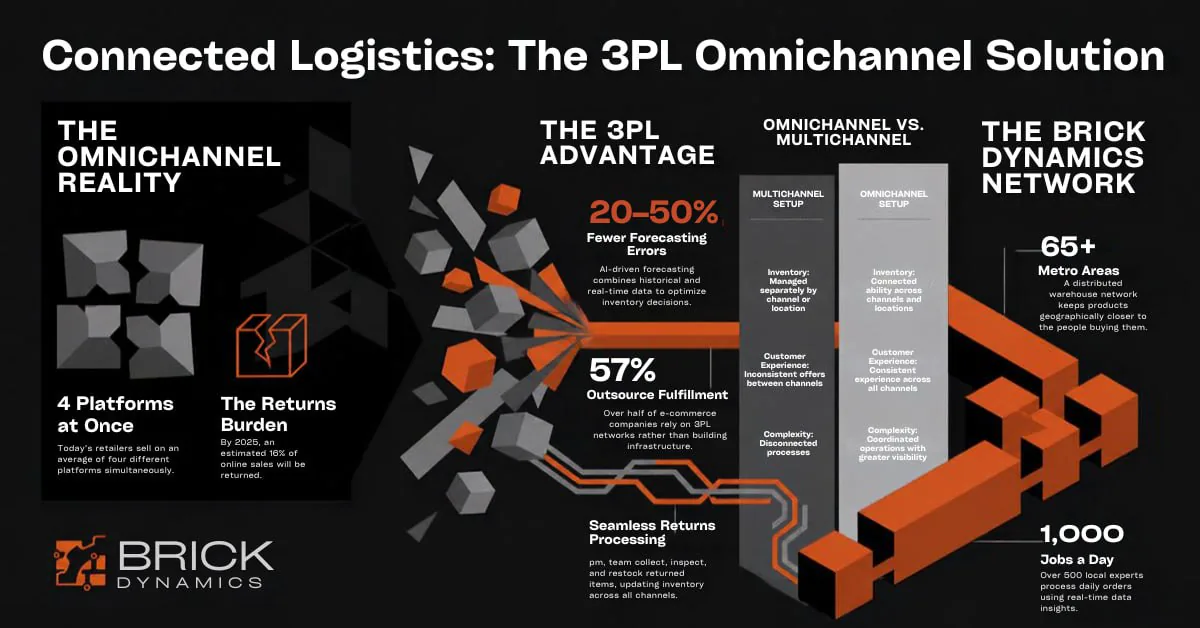
Sometimes, your business might operate multiple channels for collecting and handling customer orders. It could be through a website, a physical storefront, or an app or marketplace. Today, retailers can even sell on an average of four platforms at once
Ensuring that all of these parts work together to meet the needs of your customers is what omnichannel fulfillment services are about. With online channels accounting for 16.4% of total U.S. retail sales in 2025, according to the U.S. Census Bureau, businesses increasingly need fulfillment systems that can support both digital and physical sales.
The goal is to give your customers a consistent experience, regardless of where they choose to shop or place an order. To achieve a successful omnichannel fulfillment strategy, every part has to work together. Sales channels must be connected and work seamlessly with each other.
Orders should flow through a system that streamlines the process and maintains inventory accuracy across each channel. Your logistics partner also has to be ready to deliver, support pickup, or handle whichever fulfillment option the customer chooses.
However, connecting several channels is not always simple. As a business grows, it becomes harder to track stock across locations, keep order data accurate, deliver on time, and meet consumer expectations. Without solid systems and fulfillment infrastructure, small gaps can turn into late deliveries, missing stock, and frustrated customers.
What Is the Difference Between Multichannel and Omnichannel Fulfillment?
Both multichannel and omnichannel strategies handle orders from more than one sales channel. The difference is how closely those channels work together. In a multichannel setup, each channel may run its own inventory and fulfillment process.
Omnichannel fulfillment ties those channels together, so inventory, orders, and fulfillment teams can work from the same place. That usually creates a smoother experience for customers, no matter where they shop. Here is a quick comparison.
| Fulfillment Area | Multichannel Fulfillment | Omnichannel Fulfillment |
|---|---|---|
| Sales Channels | Multiple sales channels operate independently | Multiple channels work as connected parts of one operation |
| Inventory Management | Inventory may be managed separately by channel or location | Inventory visibility is connected across channels and locations |
| Order Fulfillment | Orders may follow separate processes depending on the channel | Orders can be coordinated and routed across the fulfillment network |
| Customer Experience | The experience may differ between channels | The goal is a consistent experience across channels |
| Fulfillment Flexibility | Customers may have limited fulfillment options | Customers can have more flexible delivery, pickup, and return options |
| Operational Complexity | Simpler to establish but can create disconnected processes | More complex to coordinate but provides greater operational visibility |
The option you choose depends on your operations and what you want to achieve. But once you are selling through more channels and serving more locations, omnichannel order fulfillment is often the stronger choice. It connects inventory, orders, and fulfillment for a more consistent customer experience, and your team has fewer disconnected processes to manage.
How Does Omnichannel Fulfillment Work?
Think of omnichannel fulfillment as a relay race. Each handoff has to happen at the right time. It starts when a customer places an order, then moves through inventory checks, routing, picking, packing, and shipping. Here is what that journey typically looks like.
-
Step 1. The Customer Places an Order
The process starts when a customer places an order. Whether that is on your website, through a marketplace, in a store, or somewhere else you sell.
-
Step 2. The Order Enters a Connected System
The order lands in a shared system that pulls in information from each sales channel. From there, the business can process it and decide what should happen next.
-
Step 3. Inventory Availability is Checked
The system checks inventory to confirm where the product is available. This helps determine the best location to fulfill the order from.
-
Step 4. The Order Is Routed
Next, the order is sent to the warehouse or distribution center best positioned to handle it quickly and efficiently. This ensures customer satisfaction.
-
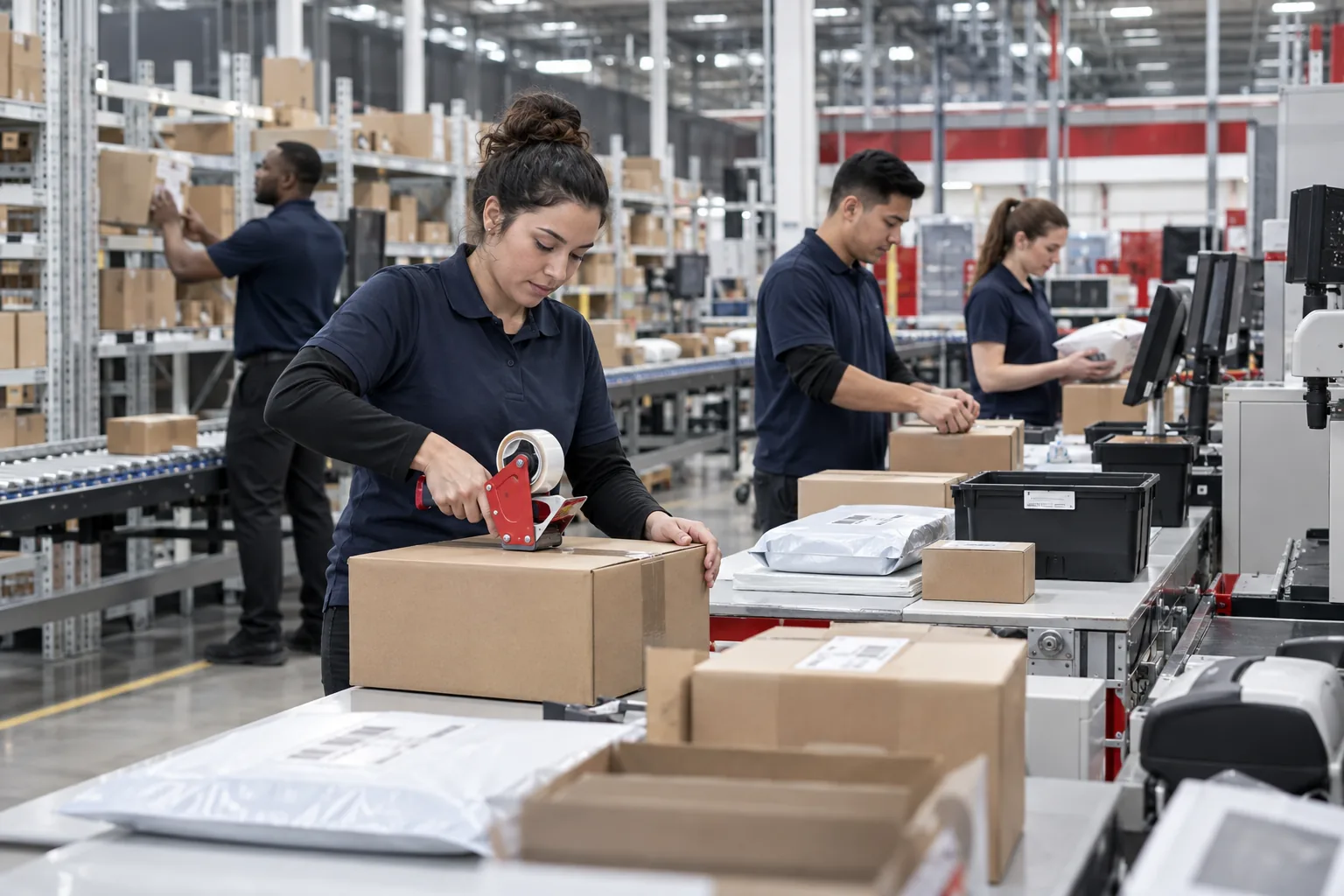
Step 5. Warehouse Teams Pick and Pack the Order
Warehouse teams pick the right items and pack them to match the customer’s order and delivery requirements. This ensures the correct products are prepared for shipment.
-
Step 6. The Order Is Shipped
The order is shipped to the customer once it has been prepared. Inventory levels and the customer’s order status are updated during the process.
-
Step 7. Returns Are Processed When Necessary
If an item comes back, the team inspects it and decides what to do next. Depending on its condition, it may go back into stock or be handled another way.
The importance of this connected system is that it keeps inventory information updated and updates customers throughout the process. If a product needs to be returned, the same network can help process the return and update inventory accordingly.
How Do 3PLs Manage Different Sales Channel Requirements?
Different channels play by different rules, and a third-party logistics provider adapts the order fulfillment process accordingly. Direct-to-consumer (DTC) orders may call for single-item shipments, branded packaging, and local delivery.
Marketplace orders can come with platform-specific rules. Retail deliveries may need appointments, labels, or shelf-ready packaging, while B2B and wholesale orders often involve larger quantities, pallets, and different delivery schedules.
A 3PL can handle those channel-specific needs without splitting your operation into separate parts. One customer might need careful protective packaging and fast delivery, while a retail shipment needs store labels and shelf-ready cartons. A B2B order may need pallets or bulk packaging. The requirements stay distinct, but with the right 3PL, inventory and fulfillment remain connected behind the scenes.
What Are the Challenges in Omnichannel Fulfillment and 3PL Solutions?
You may face several challenges when handling order fulfillment from multiple sales channels by yourself. Inventory and orders can become harder to track across multiple warehouses and different customer platforms, especially when the same item is selling online, on a marketplace, and in a store.
Businesses may also deal with overselling, stockouts, order routing issues, shipping delays, and different delivery expectations across channels. Managing these issues while maintaining a consistent customer experience can become difficult as order volumes grow.
3PL providers help bring order to that complexity with connected technology and logistics know-how. Shared inventory and order-management systems can show what is happening across channels and warehouse locations, update stock levels, route orders from the right facility, and coordinate shipping and returns. A seasoned third-party logistics (3PL) provider can also help you adjust when demand shifts and volume picks up.
How Do 3PL Warehouses Handle Omnichannel Returns?
Customers may return products bought through a website, marketplace, or physical store, making returns an important part of omnichannel fulfillment. The National Retail Federation estimates that 19.3% of online sales will be returned in 2025, which shows how quickly returns can become an operational challenge.
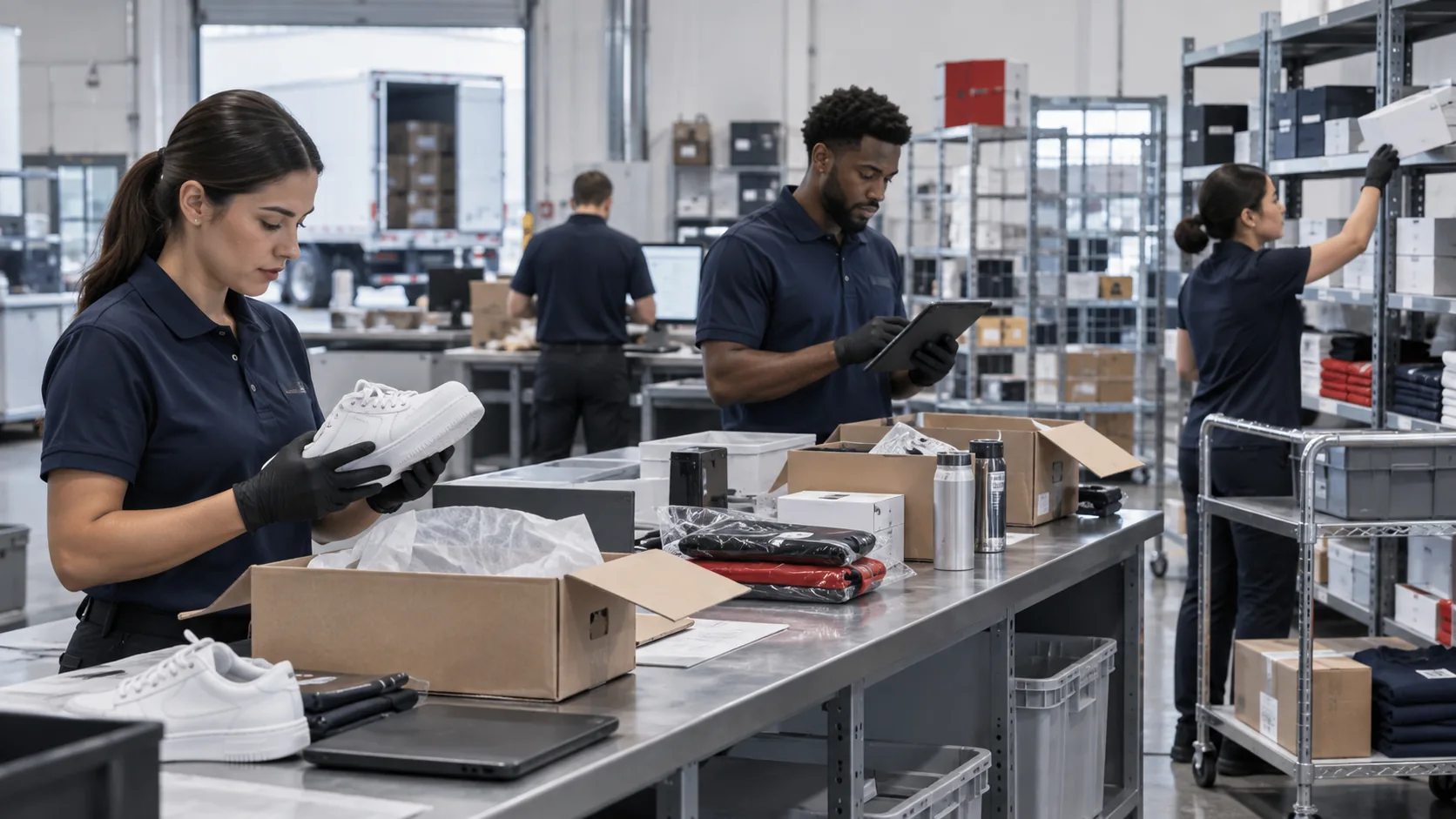
3PL warehouses can manage these cross-channel returns by receiving products, inspecting them, and deciding what happens next. Depending on the product’s condition, it may be restocked, repaired, or set aside for further review.
There is more to returns than receiving a box. 3PL teams can arrange collection, move items to the right facility, and update inventory once they have been processed. That keeps returned stock visible across channels instead of forcing your team to manage a separate return process for each one.
What is The Role of 3PL Warehouses in Omnichannel Fulfillment?
As your business grows, handling orders across several sales channels may start to feel overwhelming. Inventory may be spread across warehouses, while logistics decisions pile up quickly. Roughly 57% of e-commerce companies now outsource some or all of their fulfillment operations, according to Radial. For businesses selling across multiple channels, a 3PL can provide the warehousing and logistics support needed to manage that complexity.
A 3PL can also take pressure off your team by managing stock across locations and giving you a live view of what is available, where it is stored, and what can ship next. They can make order processing quicker and more reliable. When an order comes in, warehouse teams pick, pack, and prepare it according to the required fulfillment method. A well-run process reduces the picking and packing mistakes that lead to wrong orders or delays. It also helps get products out the door sooner, even when several channels are busy at the same time.
Warehouse management systems (WMS) can also help businesses reach customers across a wider geographic area. A network of strategic warehouse placement can bring inventory closer to different customer groups, making delivery faster. This network also gives businesses more capacity during busy periods. Rather than building a new facility every time you enter a market, you can use a 3PL’s existing resources to scale fulfillment as demand changes.
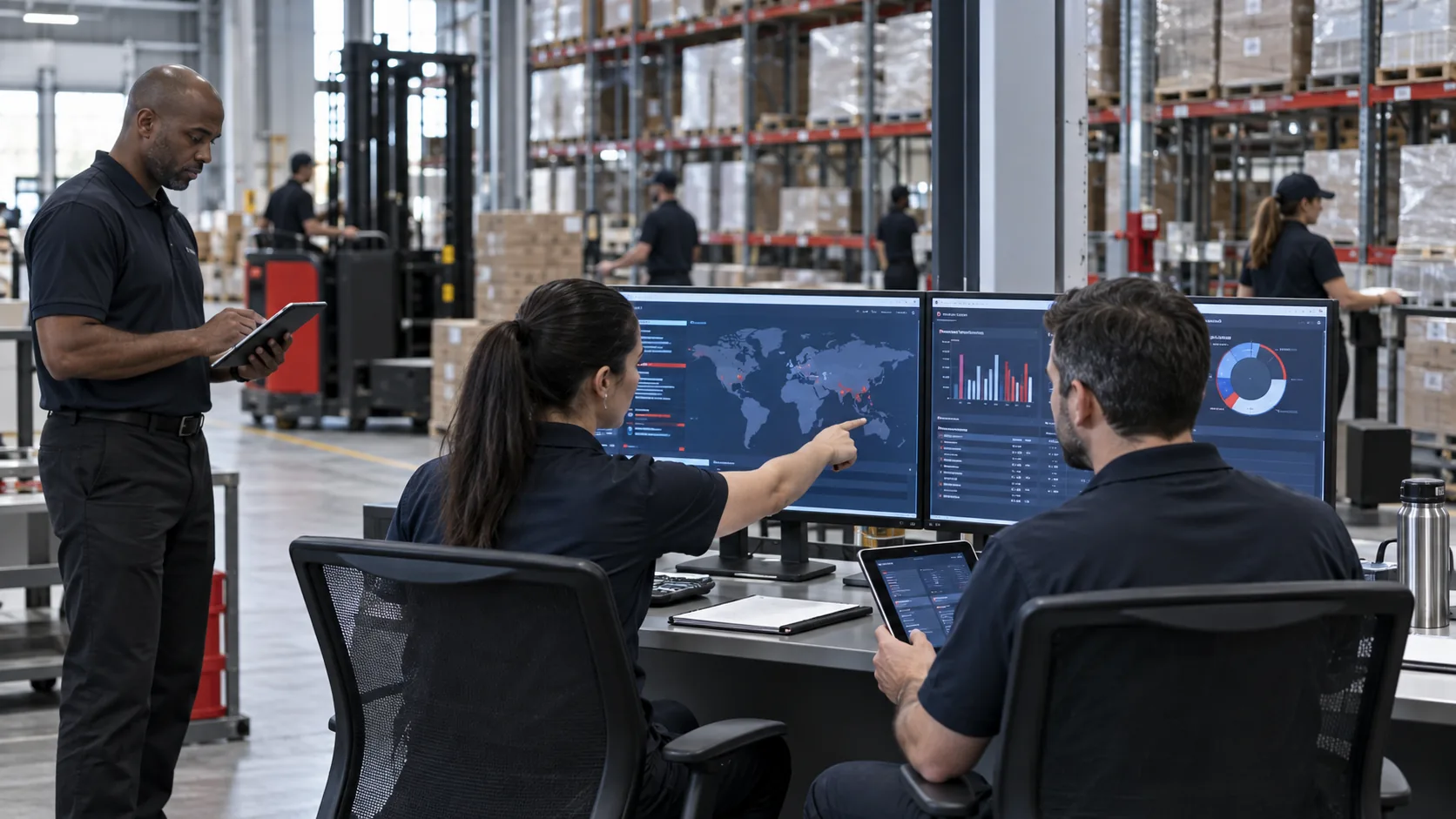
Advanced Technology Tools in 3PL Warehouses
The rise of technology is making it easier for 3PLs to get a clearer view of what is happening inside their operations. AI and machine learning can look at past orders, seasonal patterns, and inventory data to help predict demand and prepare stock ahead of time. AI-driven forecasting that combines historical and real-time data can reduce supply chain forecasting errors by 20–50%. This helps warehouse teams make quicker decisions about inventory, orders, and dispatch.
Order processing is no longer limited to manual work. Many 3PL warehouses now use automation to support picking, packing, inventory tracking, and order handling. The investment trend is growing, with North American companies ordering nearly 18,000 warehouse robots worth about $1.2 billion in the first half of 2026, according to The Times.
Inventory tools can also update stock as goods arrive, are picked, or leave the warehouse, helping teams reduce discrepancies and move orders along faster. That gives teams a current picture of what is available and where it is, helping them avoid discrepancies, reduce errors, and move orders along faster.
What Are the Benefits of Using 3PL Warehouses for Omnichannel Fulfillment?
A 3PL warehouse can ease both the cost and workload of omnichannel fulfillment. Instead of carrying all the expense of warehouse space, equipment, and fulfillment staff yourself, you can tap into an established operation. Because 3PLs work across existing networks and volumes, they can also create efficiencies that are difficult to build alone. Faster deliveries, accurate orders, and smoother returns add up to a better customer experience.
3PL warehouses can also give businesses more time to focus on their main activities. Instead of managing every warehouse and logistics task, your team can focus on developing products, marketing, sales, and customer relationships. Brands gain access to logistics professionals who understand inventory management, fulfillment, transportation, and supply chain management operations. Their experience and established processes can help you improve operations and meet customer expectations.
Picture a growing retailer selling through its website, marketplaces, and physical stores. At first, one warehouse may be enough. But as orders rise, deliveries slow down, and returns become more complicated. With Brick Dynamics, that retailer could use distributed warehouse locations to keep stock closer to customers while we manage inventory movement, fulfillment, delivery, and returns. The business can expand without having to build new warehouse infrastructure in every market.
How Do You Choose a 3PL for Omnichannel Fulfillment?
Choosing a 3PL starts with an honest look at your current operation and where you expect it to go next. Consider geographic coverage first, especially if you sell in several markets. A strong network of warehouses can keep inventory closer to customers and support faster fulfillment. You should also check the provider’s technology and inventory visibility. Connected systems should give you a clear view of inventory across warehouses and sales channels, while integrations and reporting help you track online orders, shipments, returns, and stock levels.
Next, review the provider’s fulfillment capabilities and channel experience. Can it handle direct-to-customer (DTC) orders, marketplace rules, retail shipments, and B2B or wholesale volume? Packaging, labels, shipping, and delivery needs vary by channel, so your 3PL should manage those differences without slowing things down. Do not overlook returns, either. Ask how the provider handles collection, inspection, restocking, and reverse logistics.
Finally, consider whether the 3PL can scale with your business. Order volumes can change during seasonal periods, or when you enter new markets, so your provider needs enough capacity to keep up. Look for clear reporting and a logistics team that can give you useful insight into your operations. The right 3PL should do more than store and ship your products. It should give you the infrastructure and expertise to manage fulfillment across your sales channels as your business grows.
Why Should You Use a 3PL for Omnichannel Fulfillment?
As you add websites, marketplaces, stores, and B2B channels, fulfilling every order can get complicated quickly. A 3PL connects inventory, fulfillment, shipping, and returns across those channels, giving you a clearer view of the operation. You gain faster processing, better accuracy, flexible warehouse capacity, and logistics expertise without having to build and run every piece yourself.
For businesses growing into new markets, a 3PL can be a practical way to support that momentum. Instead of repeatedly adding warehouse space, staff, and logistics resources, you can rely on a fulfillment network built to adapt as demand changes. When omnichannel fulfillment starts to outgrow your internal setup, a 3PL can provide the support and infrastructure to keep customers served across channels.
At Brick Dynamics, we have spent the past three years helping businesses manage warehousing, fulfillment, inventory, and logistics across 65 U.S. states. Our network of local experts supports distributed warehousing, real-time inventory visibility, fulfillment, delivery, and returns across growing markets. If you need a more connected way to run omnichannel fulfillment, reach out to us so we can provide the physical infrastructure to help you scale.
Frequently Asked Questions
Still wondering how 3PL warehouses support omnichannel fulfillment? Here are answers to a few questions businesses often ask about inventory, fulfillment, and returns.
What Is a 3PL Warehouse?
A 3PL warehouse stores, manages, and fulfills inventory for another business. Depending on the provider, it may also pick, pack, ship, and manage returns.
How Do 3PL Warehouses Support Omnichannel Fulfillment?
3PL warehouses connect inventory, order fulfillment, shipping, and returns across different sales channels. This helps businesses keep orders moving while giving them better visibility into their inventory and fulfillment operations.
What Is the Difference Between Multichannel and Omnichannel Fulfillment?
Multichannel fulfillment handles orders from several sales channels, but those channels may operate independently. Omnichannel fulfillment connects them so inventory, orders, and fulfillment can work together.
Why Is Technology Important in Omnichannel Fulfillment?
Technology keeps inventory, orders, and shipments visible across channels and multiple locations. It also gives fulfillment teams the information they need to process orders accurately and make faster decisions.
Can a 3PL Manage Returns Across Multiple Sales Channels?
Yes. A 3PL can manage returns from websites, marketplaces, stores, and other sales channels. It can receive and inspect products, arrange collection, update inventory, and return eligible items to stock.