
Benefits of Experiential Marketing
Experiential marketing creates meaningful interactions that help brands build emotional connections, increase customer engagement, and leave lasting impressions on their target audience. Unlike traditional advertising, experiential marketing focuses on immersive experiences that encourage active participation and stronger customer relationships. As digital marketing strategies evolve, brands increasingly use experiential marketing events, pop-up shops, and interactive experiences to generate social media buzz and valuable customer insights.
At Brick Dynamics, we help brands develop experiential marketing strategies like brand activations that create memorable experiences, strengthen customer loyalty, and support long-term brand growth. Our approach focuses on combining creativity, audience engagement, and operational execution to deliver campaigns that leave a lasting impression. Contact our team to create experiential marketing campaigns that build stronger customer relationships and increase brand awareness.
The blog explores the benefits of experiential marketing, how immersive campaigns strengthen customer engagement, and why meaningful brand experiences support long-term business growth.
What are the Key Benefits of Experiential Marketing?
Experiential marketing offers brands a more engaging way to connect with their target audience through immersive and memorable experiences. Unlike traditional advertising, experiential marketing focuses on meaningful interactions that encourage participation, emotional connection, and long-term customer engagement. These campaigns often create stronger brand visibility because audiences actively experience the brand instead of passively consuming promotional content. In our experience, successful experiential marketing campaigns perform best when they combine creativity with meaningful audience interaction. The following benefits explain why experiential marketing continues to shape modern marketing strategies across industries.
1. Increased Brand Awareness

Experiential marketing campaigns help brands increase visibility by creating unique and memorable experiences that audiences naturally want to share. Interactive experiences, pop-up shops, and experiential marketing events often generate strong social media buzz and user-generated content across multiple platforms. Research from the EventTrack study found that 74% of consumers are more likely to purchase promoted products after engaging with branded event marketing experiences. This extended engagement helps brands increase visibility beyond the physical event itself. In many cases, audience participation becomes part of the marketing strategy.
2. Stronger Emotional Connections
Experiential marketing focuses on creating meaningful engagement that helps brands establish emotional connections with their audience. People are more likely to remember brands that create positive and memorable experiences through direct interaction. A study published by the National Institutes of Health found that emotionally engaging experiences improve long-term memory retention more effectively than passive exposure. These emotional responses often strengthen brand perception and create lasting impressions that traditional advertising methods struggle to achieve. As TJ Hennessy explains, “People remember experiences far longer than advertisements.”
3. Higher Customer Engagement
Experiential marketing encourages active participation instead of passive viewing, which often leads to stronger customer engagement. Interactive elements such as live demonstrations, immersive experiences, and virtual reality experiences help audiences connect more directly with the brand. This type of engagement keeps customers involved longer and increases overall campaign impact. It also creates more opportunities for meaningful interactions between brands and potential customers. Higher engagement levels often lead to stronger customer relationships over time.
4. Valuable Customer Insights
Experiential marketing events give brands direct access to customer reactions, preferences, and behaviors during live interactions. These experiences often provide valuable insights that help improve future marketing efforts and campaign strategies. Brands can gather feedback through conversations, social media interactions, and audience participation throughout the event. In some cases, live engagement reveals customer preferences that traditional marketing research may overlook. These insights help experiential marketers create more effective campaigns in the future.
5. Increased Customer Loyalty
Positive and memorable experiences often help brands foster brand loyalty and strengthen repeat business over time. Customers who feel emotionally connected to a brand are more likely to maintain long-term relationships and recommend the brand to others. Experiential marketing creates opportunities for brands to build trust through meaningful engagement and customer-focused interactions. We have seen that campaigns centered on authentic experiences often generate stronger loyalty than heavily promotional campaigns. Strong customer loyalty also contributes to long-term brand success.
6. Better Social Media Engagement
Experiential marketing campaigns naturally encourage audiences to create and share content across social media platforms. Interactive experiences and visually engaging activations often increase social media engagement and brand visibility during campaigns. User-generated content also helps brands extend campaign reach without relying entirely on traditional advertising methods. Successful campaigns typically create experiences that people genuinely want to talk about and share online. This combination of live engagement and digital exposure can significantly amplify marketing efforts.
Common Mistakes Brands Make With Experiential Marketing

Experiential marketing can create strong customer engagement and lasting brand loyalty, but poorly planned campaigns often fail to deliver meaningful results. In many cases, brands focus heavily on visuals and entertainment without creating experiences that support long-term marketing goals. This can generate temporary attention while limiting customer engagement, emotional connection, and future campaign success. In our experience, successful experiential marketing campaigns balance creativity with clear strategic purpose and audience relevance. Understanding these common mistakes helps brands create more effective experiential marketing strategies and avoid wasted marketing efforts.
One common mistake is prioritizing social media buzz over meaningful customer interactions. Some experiential marketing events focus heavily on visually impressive setups designed only for online sharing. While these campaigns may generate short-term attention, they often fail to create lasting emotional connections or meaningful engagement with potential customers. Audiences are more likely to remember experiences that feel authentic and interactive rather than overly promotional. As Thomas O’Brien notes, “Attention without connection rarely creates lasting customer loyalty.” Strong experiential marketing focuses on customer experience first and social media exposure second.
Another issue occurs when campaigns fail to align with the brand’s values, audience expectations, or overall marketing strategy. In some cases, brands create immersive experiences that attract attention but feel disconnected from their products or messaging. This can confuse audiences and weaken brand perception instead of strengthening it. Experiential marketing campaigns perform best when the experience naturally reflects the brand’s identity and customer expectations. Clear alignment helps create stronger customer relationships and more positive associations.
Brands also make mistakes when they overlook post-event engagement and long-term relationship building. Experiential marketing should not end once the event or activation is over. Following up through social media interactions, customer feedback, and future marketing efforts helps maintain engagement after the campaign ends. We have seen that campaigns with strong follow-up strategies often generate stronger customer loyalty and repeat business. Ongoing engagement helps transform short-term experiences into long-term customer relationships.
How Successful Experiential Marketing Campaigns Create Long-Term Growth
Successful experiential marketing campaigns do more than create temporary excitement or social media buzz. The strongest campaigns help brands build customer loyalty, strengthen brand perception, and create meaningful connections that support long-term business growth. In our experience, experiential marketing performs best when campaigns balance creativity with strategy and audience relevance. Brands that focus only on entertainment often miss opportunities to create lasting emotional connections and valuable customer relationships. The I.M.P.A.C.T Framework helps brands create experiential marketing strategies that support stronger engagement and long-term campaign success.
Immerse
Successful experiential marketing campaigns create immersive experiences that fully involve the audience in the brand story. Interactive experiences such as pop-up shops, live activations, and virtual reality experiences help audiences engage more directly with the brand. These campaigns often create stronger emotional connections because customers actively participate instead of passively observing marketing messages. In our experience, immersive experiences perform best when they feel authentic and customer-focused rather than overly promotional. Creating meaningful engagement should always take priority over visual spectacle alone.
Memorability
Memorable experiences help brands stay relevant long after experiential marketing events end. Customers are more likely to recall brands that create interactive and emotionally engaging moments instead of passive promotional messaging. These experiences often strengthen brand perception and create more lasting customer relationships over time. In our experience, campaigns that combine emotional engagement with meaningful interaction usually leave the strongest lasting impression. Strong memorability also increases repeat engagement and word-of-mouth marketing.
Participation
Experiential marketing campaigns become more effective when audiences actively participate in the experience instead of simply observing it. Interactive elements encourage deeper customer engagement and stronger emotional investment throughout the campaign. In many cases, participation also increases social media engagement because audiences naturally share experiences they helped create. Campaigns that encourage meaningful interactions often generate stronger user-generated content and customer loyalty. Strong participation transforms audiences from observers into active brand advocates.
Authenticity
Experiential marketing campaigns perform best when they align naturally with the brand’s values, voice, and customer expectations. Some campaigns attract attention visually but fail to create meaningful engagement because the experience feels disconnected from the brand itself. This often weakens customer trust and reduces long-term campaign impact. Authentic experiences create stronger emotional connections because audiences feel the interaction is genuine rather than heavily promotional. In our experience, authenticity often matters more than campaign size or production value.
Connection
Strong experiential marketing strategies focus on building meaningful customer relationships instead of generating temporary attention. Creating emotional connections helps brands foster customer loyalty and improve long-term customer engagement. Research from PwC found that 73% of consumers consider customer experience an important factor in purchasing decisions. Brands that create positive and memorable experiences are often more successful at maintaining long-term customer relationships. Meaningful connections also strengthen brand perception and repeat business over time.
‘Talkability’
Successful experiential marketing campaigns naturally encourage audiences to talk about the experience online and offline. Social media buzz, word-of-mouth marketing, and user-generated content often extend campaign reach beyond the original event. Interactive experiences that feel unique and emotionally engaging are more likely to be shared across social media platforms. However, campaigns focused only on viral attention sometimes struggle to create lasting customer engagement. As Thomas O’Brien explains, “The most effective campaigns give people something worth remembering and sharing.”
Experiential Marketing vs Traditional Marketing
Experiential marketing and traditional marketing both aim to increase brand awareness and customer engagement, but they approach audiences in very different ways. Traditional marketing methods often rely on one-way communication through advertisements, print campaigns, television, and digital promotions. Experiential marketing, however, focuses on creating interactive experiences that encourage direct participation and emotional connection. In our experience, audiences are more likely to remember brands they actively engage with rather than brands they simply observe. The comparison below highlights the major differences between experiential marketing and traditional advertising approaches.
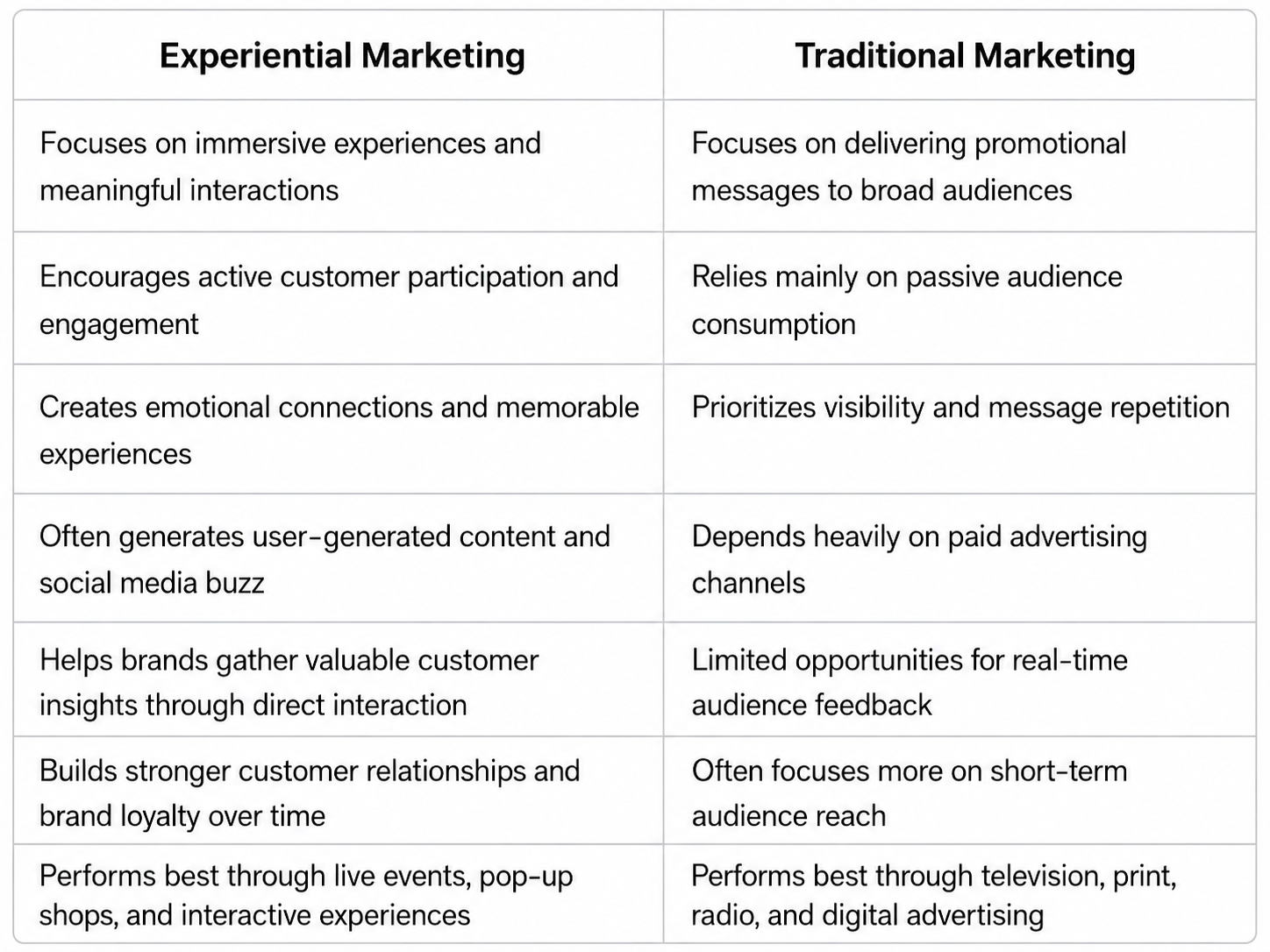
The most effective marketing strategies often combine elements of both experiential marketing and traditional advertising. In some cases, experiential campaigns create stronger emotional engagement, while traditional marketing supports broader audience reach and campaign visibility.
Why Experiential Marketing Matters for Long-Term Brand Growth
Experiential marketing helps brands build stronger customer relationships by creating meaningful interactions that continue influencing customer perception long after campaigns end. Unlike traditional advertising, experiential marketing focuses on emotional engagement and memorable experiences that encourage deeper customer connections. These experiences often create positive associations that improve brand perception and customer loyalty over time. In our experience, brands that prioritize meaningful engagement usually create stronger long-term customer relationships. Lasting emotional connections often become a major driver of repeat business and customer retention.
Experiential marketing also supports long-term growth by increasing customer engagement across both physical and digital marketing channels. Interactive experiences often generate user-generated content, social media engagement, and word-of-mouth marketing that continue expanding campaign reach after the event itself. This extended visibility helps brands maintain stronger audience engagement without relying entirely on traditional advertising methods. In some cases, successful experiential campaigns continue influencing future marketing efforts months after the original activation. Strong engagement often creates more sustainable brand visibility over time.
Another important benefit is the ability to gather valuable customer insights through direct audience interaction and live engagement. Experiential marketing events allow brands to observe customer behavior, preferences, and reactions in real time. These insights often help experiential marketers improve future campaigns, strengthen customer experience strategies, and create more effective marketing efforts. Brands that understand their audience more clearly are usually better positioned to adapt as customer expectations evolve. This creates stronger alignment between marketing strategies and customer needs.
Long-term brand growth also depends on consistency between brand values, customer experience, and campaign execution. Some experiential campaigns create temporary excitement but fail to support long-term customer loyalty because the experience feels disconnected from the brand itself. Strong experiential marketing strategies create immersive experiences that reinforce brand identity while maintaining authentic customer engagement. As TJ Hennessy explains, “Customers stay loyal to brands that consistently create meaningful experiences.” Brands that maintain this consistency are often more successful at building loyal customer bases and long-term marketing value.
Ready to Create Experiences That Build Stronger Brands?

Experiential marketing helps brands create stronger emotional connections, increase customer engagement, and build long-term brand loyalty through immersive and memorable experiences. Successful campaigns often combine meaningful interactions, audience participation, and authentic brand storytelling to create lasting customer relationships and stronger brand visibility. What makes this guide different is its focus on practical campaign strategy, common experiential marketing mistakes, and real-world insights that help brands create more meaningful and effective customer experiences.
At Brick Dynamics, we help brands create experiential marketing strategies that strengthen customer relationships, increase brand visibility, and deliver memorable campaign experiences. Connect with our team to build experiential marketing campaigns that create meaningful engagement and long-term brand impact.
Frequently Asked Questions
Here are quick answers to common questions about experiential marketing and brand engagement strategies.
What Is Experiential Marketing?
Experiential marketing is a strategy that engages audiences through immersive and interactive brand experiences. These campaigns focus on creating memorable interactions that strengthen emotional connection and customer engagement.
How Can Experiential Marketing Benefit Brick Dynamics?
Experiential marketing can help Brick Dynamics increase brand awareness, strengthen customer loyalty, and improve audience engagement. It also helps create memorable experiences that support long-term brand growth and customer relationships.
What Are Examples of Experiential Marketing Tactics Brick Dynamics Can Use?
Brands can use pop-up events, interactive product demonstrations, branded activations, virtual reality experiences, and influencer collaborations. These tactics help create meaningful engagement and stronger customer interactions across marketing channels.
How Can Brick Dynamics Measure Experiential Marketing Success?
Campaign success can be measured through customer engagement, social media interactions, user-generated content, audience feedback, and overall brand visibility. Brands may also evaluate customer sentiment and future campaign performance after the experience ends.
What Are the Best Practices for Experiential Marketing Campaigns?
Successful experiential marketing campaigns usually begin with clear goals and strong audience understanding. Brands should also prioritize authentic engagement, seamless execution, and post-event customer follow-up to maintain long-term engagement.