How Much Does 3PL Cost (2026)?
Third-party logistics (3PL) services do not have a single price. The rates depend on your order volume, inventory footprint, product profile, and the services you buy. Understanding each fee makes it easier to build a realistic budget and spot charges that are missing from a quote.
Brick Dynamics supports distributed operations across 65+ metro nodes with a 10K+ field workforce and a 98.5%+ on-time delivery rate. Its operating layer connects local warehousing, transportation, inventory visibility, field coordination, and reverse logistics so growing teams can add markets without building every local operation themselves.
This guide explains current 3PL cost benchmarks, the fees included in a typical proposal, and a repeatable way to compare providers.
How Much Would You Pay for 3PL Services in 2026?
The 2026 Warehousing and Fulfillment Costs & Pricing Survey from The Fulfillment Advisor, based on responses from 500 warehousing and fulfillment providers, reports an average of $3.21 for a one-item D2C pick-and-pack order and $4.86 for a one-item B2B order. The same survey reports $19.37 per pallet per month, $8.75 to receive a pallet, and $3.56 to process a return.
Those figures are service-level benchmarks, not all-in delivered prices. Carrier postage, packaging materials, receiving, storage, account fees, and surcharges may appear on separate lines. This article labels every example as including or excluding shipping so that unlike costs are not mixed together.
The types of products you ship can affect what you pay. A brand that ships light goods with a single SKU will pay a lot less than one that ships heavy, multi-item consignments.
The table below shows the usual cost structure in 2026 for most brands. Use it as a reference point when evaluating any quotes you get.
| Cost Category | 2026 Benchmark |
|---|---|
| Pick & pack (first item) | $3.21 average for a one-item D2C order |
| Additional item | $0.48 average per additional item |
| Pallet storage (monthly) | $19.37 average per pallet |
| Receiving/inbound | $8.75 average per pallet |
| Returns processing | $3.56 average per return |
| Setup fee | $373.06 average in the 2026 survey; 55% of providers charged one |
| Monthly minimum | $752.08 average in the 2026 survey; verify the current contract threshold |
| All-in cost per order (mid-volume) | Quote-specific; calculate it from every applicable fee and state whether postage is included |
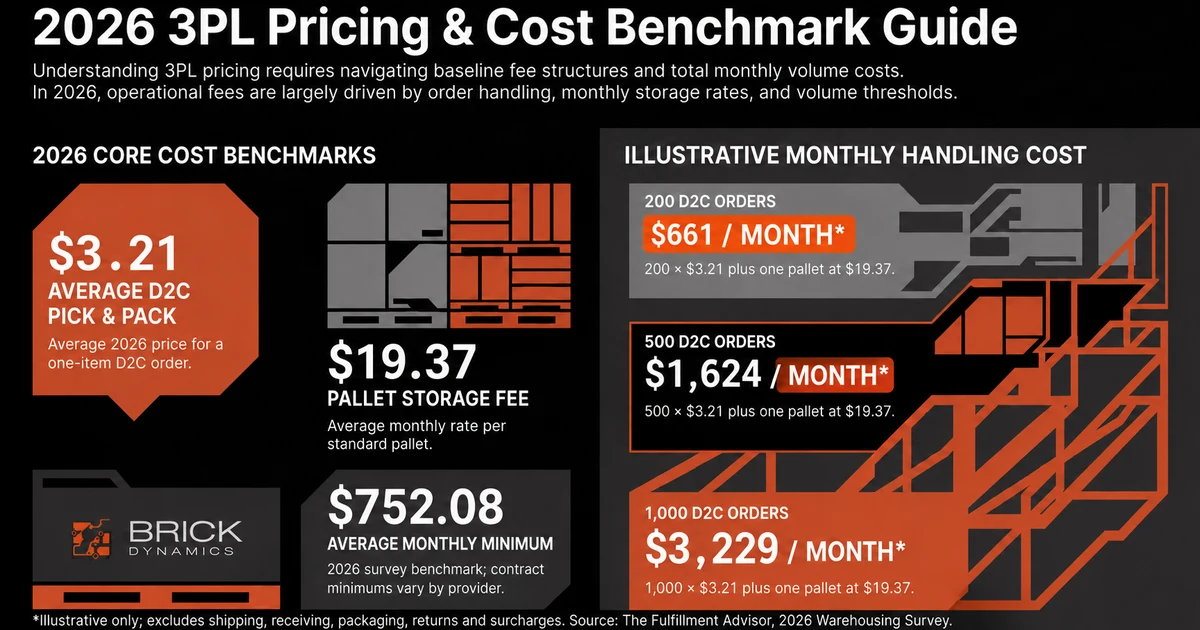
2026 3PL Cost Benchmarks
Survey benchmarks and illustrative monthly handling costs. Shipping and other fees are excluded.
What Are the Fees Included in 3PL Costs?
While 3PL quotes vary, most include the same basic fees. It’s much easier to compare providers if you know what each charge entails. Below is a breakdown of the most common fees and what impacts them.
- Inbound receiving and inventory check-in
- Storage by pallet, bin, shelf, or cubic foot
- Pick-and-pack fulfillment
- Packaging materials and labeling
- Shipping and transportation
- Returns and reverse logistics
- Value-added services such as kitting or assembly
1. Inbound and Receiving Fees
Before inventory reaches a storage location, it must be received, unloaded, counted, and inspected. The 2026 survey average is $8.75 per pallet, $2.25 per carton, or $500 per container. Providers may instead charge by SKU or labor hour, so the quote should identify both the billing unit and the work included.
2. Storage Fees
After check-in, storage becomes an ongoing expense. The 2026 survey average is $19.37 per pallet per month, with reported rates from about $6 to $40. Smaller inventories may be billed at $3.03 per bin or $0.45 per cubic foot on average. Ask when long-term storage starts and how the surcharge is calculated, because aged-inventory policies vary by provider.

3. Pick-and-Pack Fees
This charge covers locating inventory, picking the ordered units, and preparing the order for shipment. The 2026 survey average is $3.21 for a one-item D2C order: a $2.73 base order charge plus $0.48 for the item. Each additional item averages $0.48. The average one-item B2B order is $4.86 before freight, reflecting the extra handling, pallet preparation, documentation, and compliance work often required.
4. Packaging Costs
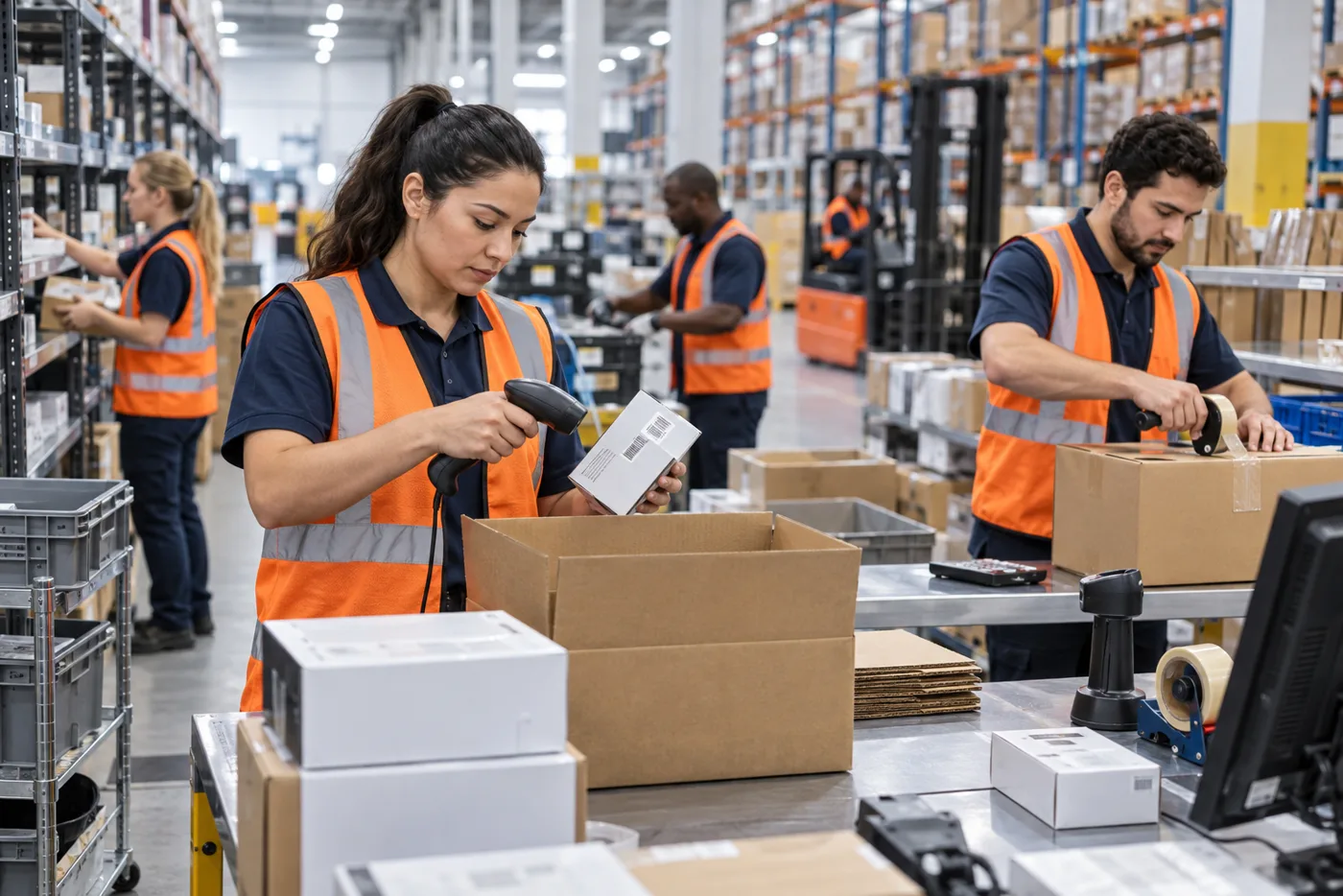
Packaging costs can add up quickly, even when each material seems inexpensive. Boxes and mailers may be priced at cost, marked up, or bundled into the pick-and-pack fee. Labels, void fill, inserts, and documentation may be separate. The 2026 survey reports an average of $0.23 for an insert, while custom or branded packaging is quote-specific.
5. Shipping and Transportation Costs
Shipping is separate from pick-and-pack in the benchmark figures used here. Carrier postage depends on package weight and dimensions, service level, destination zone, fuel, residential delivery, and peak-season surcharges. For B2B and freight shipments, request the base LTL or truckload charge together with accessorials such as liftgate, appointment, detention, and inside delivery. The proposal should state whether the 3PL passes carrier costs through, adds a markup, or lets you use your own freight account.
6. Returns and Reverse Logistics Costs
The 2026 survey average is $3.56 per return. That fee may cover check-in, inspection, and inventory disposition, but refurbishment, relabeling, repackaging, or disposal can be additional. Confirm the exact workflow and billing unit before comparing return programs.
7. Value-Added Services
Beyond basic fulfillment, kitting, assembly, labeling, quality checks, and subscription-box preparation can increase the bill. The 2026 survey reports average kitting labor of $10.79 per hour, though many providers price by kit, item, or project. Fragile, oversized, regulated, or hazardous products may require separate handling and compliance charges.
Other services, such as tagging or quality inspections before storage, can also add to your total charge. It is always a good idea to confirm exactly what is included and what costs extra before signing a contract. Once you know what each fee entails, it becomes much easier to compare quotations from different 3PL providers and avoid surprises down the line.
How Do 3PL Pricing Models Work?
Different 3PLs use different methods, and if you choose the wrong type, you might end up paying more than you intended. With the global 3PL market projected to hit $1.46 trillion in 2026, according to Research and Markets, providers are competing harder than ever, which means more pricing models to consider.
Some 3PL services use per-order pricing, while others separate the base order charge from every item picked. Using the 2026 averages, a three-item D2C order would cost about $4.17 for pick-and-pack: $2.73 for the order plus three item charges of $0.48. Packaging and postage are not included in that calculation.
Cost-Plus, Hybrid, and Custom Pricing
Cost-plus pricing charges your actual warehousing fees together with a fixed margin. Hybrid pricing combines both methods. You generally pay a flat rate per order and, in addition, pay extra for each item if the number of items in your order exceeds a certain threshold. This type of pricing can suit brands whose order quantities vary greatly from month to month.
The Fulfillment Advisor’s 2026 survey reported an average monthly minimum of $752.08 among providers that disclosed a specific minimum. If the eligible fees in your contract fall below its threshold, you pay the difference. Customized pricing is arranged directly and may suit high-volume brands or products that do not fit a standard rate card.
Which Pricing Model Fits Your Business?
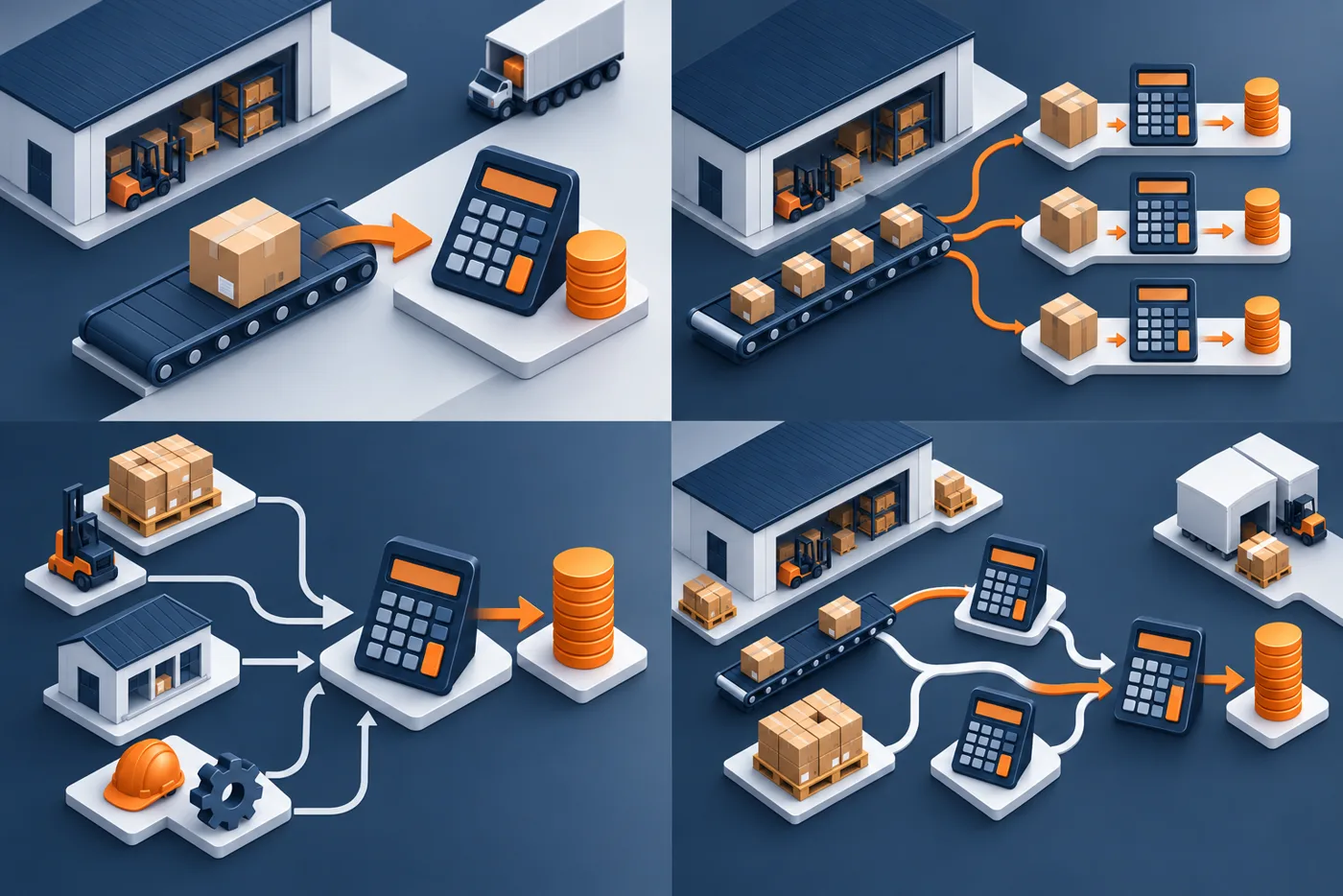
The right pricing model depends on your customers’ orders, not just which one looks cheapest at first. The table below briefly explains the common pricing models and how each option works so you can choose the one that best fits your orders.
| Pricing Model | Best For | Advantages and drawbacks |
|---|---|---|
| Per-order | Brands shipping mostly single-item orders | Simple and predictable, but multi-item orders can get pricier than expected. |
| Per-item | Multi-item orders | Costs scale with complexity, so bigger orders cost more, not less |
| Cost-plus | Brands that want full visibility into actual costs | Transparent billing, but requires trading simplicity for detail |
| Hybrid | Growing brands whose order profiles keep shifting | Flexible as you scale, but harder to predict month to month |
How Much Does Onboarding and Setting Up a 3PL Cost?
The 2026 survey reported an average setup fee of $373.06 among the 55% of providers that charged one. Setup may cover paperwork, contract review, account configuration, and inventory onboarding, but the scope varies. Ask the provider to separate setup, receiving, integration, training, and ongoing software charges.
If you are integrating automation, technology fees can rise quickly. Linking your current systems to the 3PL’s platform requires considerable engineering work, which increases costs. But using APIs and configured systems can make it easier to handle your order data. This feature becomes important as volumes increase. A few 3PLs offer this as part of their onboarding process, while others charge extra depending on how custom the integration has to be.
Custom Integrations and Fee Negotiation
Custom implementation can be expensive since it involves starting from scratch rather than using existing frameworks. Setup fees aren’t fixed, and many 3PLs are willing to drop them if you request it, especially when you’re bringing in large volume or signing up during a slow period. These fee waivers aren’t always advertised, so it’s good to ask about them before you agree.
What Are the Factors that Affect 3PL Costs?
The amount you pay depends on your order volume, the items you ship, your customers’ locations, and the kind of technology you require. If you know these factors, you can estimate your total costs rather than relying on a general rate card. Common factors include:
- Business size and monthly order volume
- Product size, weight, SKU count, and handling complexity
- Warehouse location and distance to customers
- Technology, integrations, and automation requirements
1. Business Size and Order Volume
The more shipments you make, the better the rates you get. If you’re shipping fewer than 200 orders a month, you’ll probably pay more per order than a large brand that ships thousands. Fixed costs (such as account management fees and warehouse space) are spread over fewer shipments. This makes volume very important because if your orders don’t reach the monthly minimum, you’ll have to pay the difference.
2. Product Size, Weight, and Complexity
Larger, heavier products cost more to store, pack, or ship than smaller, lighter ones. Fragile or special items require extra care and more careful packaging, which increases both time and cost. The number of SKUs you carry is also a factor. The more product types you have, the more work there is in managing inventory. And if your customers are likely to buy multiple items at once, your fulfillment costs will be higher than if most orders consist of a single item.
3. Warehouse Location and Shipping Distance
Where you store your inventory strongly affects how much you pay for shipping. If your warehouse is closer to your customers, you will pay less for shipping. You may also be able to reduce shipping costs by using more than one warehouse. However, keep in mind that keeping inventory in several locations will involve extra work and extra cost.
4. Technology and Automation Requirements
If you link your systems, such as your storefront or your inventory software, to the 3PL’s platform, you’ll save yourself the need for manual tasks. But this costs money. For real-time inventory tracking or automated workflows, you may end up paying more.
Although the initial cost can pay off over time, warehouse automation can reduce labor costs by 25 to 30 percent and increase pick accuracy to nearly 99 percent, according to Sellers Commerce. Additional costs are incurred when custom workflows are needed for specific packaging, labeling, or compliance situations.
How Do You Estimate Your 3PL Costs?
Once you know what affects pricing, you can calculate your own 3PL costs without waiting for a quote. To get an estimate, list out every fee that could apply. This can include receiving, storage, fulfillment, packaging, shipping, returns, and any extras like labeling or kitting fees. You can also work out your receiving costs based on how often and how much inventory you send in.
Calculate your storage costs based on the number of pallets or units you expect to have. Then add fulfillment, packaging, and shipping costs, since these are generally the largest expenses. Be sure to include returns, any value-added services, monthly minimum charges, and any peak-season surcharges that may apply.
The formula that you can use is as follows: total 3PL cost equals the sum of receiving, storage, fulfillment, packaging and shipping, returns, value-added services, and other applicable costs.
A Sample Monthly Cost Calculation
Suppose you handle 1,000 one-item D2C orders each month, with receiving costs of $300, storage at $800 (about 41 standard pallets at the cited $19.50 average), fulfillment at the $3.21 benchmark ($3,210), and packaging plus carrier shipping at $4,500. The total is $8,810, or $8.81 per order, including shipping. Writing out each component prevents a simple arithmetic error from distorting a provider comparison.
How Much Could a 3PL Cost Per Month?
Order volume alone does not determine a reliable monthly total. To show the math without pretending it is a quote, the infographic uses one-item D2C orders at the $3.21 survey average plus one pallet at $19.37. That produces illustrative handling totals of $661 for 200 orders, $1,624 for 500 orders, and $3,229 for 1,000 orders, rounded to the nearest dollar.
Those examples exclude receiving, packaging, returns, account fees, surcharges, and carrier postage. A real monthly estimate must add each of those costs using the shipment weights, dimensions, zones, service levels, SKU count, inventory footprint, and return rate for the business.
Why Similar Order Volumes Can Produce Different Bills
For a second example, 1,200 one-item D2C orders at $3.21 produce $3,852 in pick-and-pack fees. If storage and packaging add $2,000, the subtotal is $5,852, or $4.88 per order before shipping. Carrier postage is not included and must be added from the provider’s rate card or the shipper’s own account. Returns, receiving, and surcharges would also be separate unless the quote says otherwise.
For instance, two companies that ship the same number of orders could end up paying very different amounts. For example, one might ship fragile products while the other ships simple, light ones. Your bill can also increase or decrease because of seasonal fees, storage penalties, and minimum charges. The only way to get a realistic estimate is to work out the figures based on your own order pattern.
What Are Some Hidden 3PL Fees You Should Watch Out For?
The pick-and-pack rate on a 3PL’s homepage rarely tells the whole story. A monthly minimum can be the first surprise: the 2026 survey reported an average of $752.08 among providers that disclosed a specific minimum, with reported minimums ranging from $150 to more than $1,500. Your contract may use a different threshold and may count only selected services toward it.
Account management may also cost extra. The 2026 survey reported an average routine account-management fee of $253.33, most commonly billed monthly. Seasonal and fuel surcharges can also change throughout the year. Ask each provider for its current surcharge schedule and the dates when seasonal charges apply.
Storage, Handling, and Adjustment Charges
Storage and handling fees often hide in the fine print. Long-term storage policies may apply when inventory sits beyond the age stated in the contract. Special handling for fragile, bulky, or hazardous items usually brings extra fees as well. Kitting, labeling, and product preparation add per-unit or labor charges, while returns average $3.56 before any refurbishment, relabeling, or disposal fee.
Inventory adjustment fees can show up after stock audits, and many brands only find out when they receive the bill. While none of these fees alone is enough to stop a deal, collectively they can turn a reasonable rate into an expensive contract. To avoid being caught off guard, always request a complete list of fees before agreeing to anything.
How Do You Compare 3PL Quotes?
Comparing quotes gets a lot easier once you have a full fee schedule that covers everything from receiving and storage to packaging and returns. And don’t be shy about asking each provider what their monthly minimum is. A low headline rate can still leave you with a bigger bill if that minimum is steep.
Don’t forget to check how shipping is handled. In some contracts, carrier costs are bundled into the pick-and-pack fee, but in others they are charged separately. This can significantly affect your total bill.
Be especially careful with storage charges, since providers calculate them differently. Find out whether storage is charged per pallet, per bin, or per cubic foot, and make sure you know which method applies to your products. Also ask about any additional charges that may not be listed on the main rate card.
Review Surcharges and Contract Terms
Check peak-season pricing and the exact dates in the provider’s current surcharge schedule. If a provider cannot clearly explain how these charges will affect your bill, ask for a sample invoice. The invoice should show how each fee appears and which charges vary by season or shipment profile.
Always compare costs based on your actual order volume, not just an average. Pricing can change a lot as your business grows. Also, check the contract for things like how much notice you’ll get before rate increases and whether you’re locked into a long-term deal. A quote that looks cheap up front can get expensive if rates jump unexpectedly.
Are 3PLs Cheaper Than Managing Logistics In-House?
The answer to this depends on your operations. Handling logistics yourself involves managing a long list of separate costs. Warehouse space, labor, equipment, software, packaging, insurance, and transportation must all be included in the comparison.
On a phone, swipe horizontally to compare all columns.
| Cost | In-house | 3PL |
|---|---|---|
| Space | Lease, utilities, insurance, and unused capacity | Storage billed by pallet, bin, cubic foot, or dedicated area |
| Labor and equipment | Payroll, recruiting, training, forklifts, maintenance, and supervision | Receiving, pick-and-pack, kitting, and handling fees |
| Technology | WMS, integrations, devices, and internal support | Setup, integration, platform, or account-management fees |
| Transportation | Direct carrier contracts and internal freight management | Pass-through, marked-up, discounted, or customer-account carrier rates |
With in-house logistics, you’ll also have to buy equipment, purchase order-management software, and ensure packaging materials are always available. And all this can get really expensive and overwhelming. Don’t forget transportation, utilities, insurance, and the management time required to keep everything running. While each of these expenses may seem cheap on its own, together they add up to a substantial fixed cost.
What Changes When You Outsource
When you outsource to a third-party logistics provider, most of those costs are bundled into a few expenses. You are charged for storage, receiving, and fulfillment based on your actual usage. Shipping is either included or billed separately, but in most cases you receive better rates than you would if you handled it yourself. Third-party logistics providers also offer technologies such as inventory tracking and order routing, removing the need to buy separate software.
If you need your goods kitted, labeled, or given special handling, these services are available when required, eliminating the need to hire dedicated staff. It’s not just about cost either. According to ClickPost, 91% of businesses that outsource to a 3PL report improved customer satisfaction and stronger supply chain results.
It only makes financial sense to outsource when your order volume begins to increase, since the fixed costs of having employees on site do not scale as efficiently. It’s also a major benefit when you are entering new markets, since a third-party logistics provider already has warehouse space and staff available.
Outsourcing also involves tradeoffs. You will give up some day-to-day control over inventory and depend on the provider’s performance and communication. Choose a 3PL partner whose reporting, service levels, and operating processes match your requirements.
When In-House Logistics May Still Make Sense
Contracts may include minimum commitments and specific requirements, such as special packaging or compliance, which can increase costs. The best choice depends on your actual volume and future growth plans, so consider the advantages and disadvantages before deciding.
How Can Brick Dynamics Help Businesses Manage Their 3PL Costs?
Most 3PLs stop at basic pick-and-pack services, leaving you to figure out the rest, such as local logistics and market expansion, on your own. Brick Dynamics takes a different approach. We connect local warehousing and first- and last-mile logistics, so your inventory moves smoothly from storage to your customers’ doors.
You get real-time inventory visibility, which means fewer adjustment fees and stockouts. Returns flow through the same system, with no separate provider or extra fees. Plus, our local field teams manage on-the-ground operations, giving you hands-on support most 3PLs don’t even offer.
A Multi-Market Expansion Example
Here is an example of how it works in practice. Suppose a consumer brand wants to enter 10 new metropolitan areas without having to lease warehouses or recruit local teams. Rather than spending months and large amounts of money setting things up from the beginning, it can make use of Brick Dynamics’ ready-made network of warehouses, vehicles, and field teams. As a result, it could start operating in new markets within weeks instead of quarters, while avoiding the fixed costs associated with rent, equipment, and management overhead for each location.
This flexible infrastructure is real. For example, Stack launched in 65+ markets and reached more than $3 million in first-year revenue with a two-person team, without building local infrastructure. With Brick Dynamics, there’s no need for you to start from scratch; you obtain a flexible operating layer that takes on the demanding tasks.
How Do Businesses Reduce 3PL Costs?
Reducing 3PL costs starts with operating efficiency. Combine smaller orders into fewer, larger shipments when customer requirements allow. Use right-sized packaging to reduce material and dimensional-weight charges. Keep inventory counts accurate to limit adjustment fees and avoid reordering stock already on hand.
Reduce excess inventory because unsold items sitting in storage can accumulate long-term fees. And don’t forget location. Choosing a warehouse closer to your customers means lower shipping costs and faster deliveries.
As order volume grows, ask providers whether documented volume tiers can reduce the per-order rate. Remove value-added services you do not need, such as extra kitting or premium packaging. Use inventory and order reporting to identify inefficiencies and unexpected fees.
Check your invoices regularly, because billing mistakes happen more often than you’d think. And it’s smart to shop around every now and then, even if you’re happy with your current provider. Pricing and service levels change over time.
How Much Will You Actually Pay for 3PL Services?
What you pay depends on monthly order volume, product mix, warehouse location, and the services you use. A reliable estimate requires identifying which fees apply to the operation and asking each provider for a complete breakdown based on the same shipment profile.
If all the numbers still feel overwhelming, you’re not alone. That’s why the right partner matters. A good 3PL won’t just throw out a rate. They’ll help you understand what you’re paying for and why. For many growing businesses, outsourcing is actually less expensive than handling everything on your own.
Brick Dynamics operates across 65+ metro nodes, coordinates a 10K+ field workforce, and reports a 98.5%+ on-time delivery rate. Its model combines distributed warehousing, local transportation, field coordination, and reverse logistics in one operating layer. Contact Brick Dynamics to scope the services, markets, and service levels your program requires.
Frequently Asked Questions
Outsourcing logistics can get confusing. These answers explain the charges, contract terms, and operating details that most often affect a 3PL budget.
How Much Does 3PL Warehousing Cost?
The 2026 survey average is $19.37 per pallet each month, with reported rates from about $6 to $40 depending on market, facility, inventory volume, and storage requirements. Smaller inventories may be billed at an average of $3.03 per bin or $0.45 per cubic foot. Ask when long-term storage begins, how it is calculated, and whether seasonal inventory changes the billing unit. Your estimate should also include receiving, inventory movement, insurance requirements, and any monthly minimum stated in the contract for a fair comparison.
How Much Does a 3PL Cost per Month?
There is no defensible monthly total based on order count alone. Using the article’s narrow illustration, 200 one-item D2C orders plus one pallet of storage cost about $661 before shipping and other fees; 500 orders cost about $1,624; and 1,000 cost about $3,229. Your actual bill must also account for receiving, packaging, carrier charges, returns, account fees, service levels, and warehouse count. Build the estimate from real shipment data and test it against the provider’s minimum and surcharge schedule.
What Factors Influence the Cost of 3PL Services?
Order volume, product size and weight, SKU count, warehouse location, shipping distance, return rate, and technology requirements all influence 3PL costs. Higher volume can lower the fee per order because fixed expenses are spread across more shipments. Oversized products, fragile goods, multi-item orders, special handling, and multiple storage locations usually increase the total. Custom integrations can add setup or engineering fees as well. For a useful comparison, give each provider the same inventory profile, monthly order count, average items per order, destination mix, and return rate.
Do 3PL Companies Charge Monthly Minimums?
The Fulfillment Advisor’s 2026 survey reported an average monthly minimum of $752.08 among providers that disclosed a specific minimum. When eligible fees fall below the contracted amount, you generally pay the difference. The important detail is which charges count toward the minimum. One provider may include storage and receiving, while another may count only fulfillment. Ask for the calculation in writing, confirm whether the threshold changes by season or volume tier, and model a slow month before signing for a realistic comparison.
Are Shipping Costs Included in 3PL Fees?
Shipping treatment varies by provider and contract. Some 3PLs pass carrier charges through as a separate line item, while others bundle transportation into a broader fulfillment fee. Either approach can work, but the quote should explain fuel, residential delivery, dimensional weight, remote-area, and peak-season surcharges. It should also state whether the provider applies a markup to carrier rates. Compare quotes using the same package dimensions, weights, service levels, and destination zones. A low pick-and-pack fee can still produce a higher total if transportation terms are less favorable.
Are There Hidden Fees Associated With 3PL Services?
Charges that are easy to overlook include monthly minimums, long-term storage, inventory adjustments, packaging markups, account management, return processing, disposal, and peak-season surcharges. Fragile, bulky, or hazardous products may also require special handling, while kitting, labeling, and compliance work can add per-unit fees. Request a complete fee schedule rather than relying on the headline pick-and-pack rate. A sample invoice based on your order profile is even more useful because it shows where each charge appears and which fees can change with volume, season, or inventory age.
How Do I Compare 3PL Quotes?
Compare the total expected monthly cost, not only the advertised pick-and-pack rate. Give every provider the same operating data, including orders per month, units per order, pallet count, product dimensions, destination zones, returns, and required value-added services. Then request a full fee schedule and a sample invoice. Review storage units, carrier treatment, monthly minimums, peak surcharges, rate-increase notice, and contract length. This approach exposes differences that headline pricing hides and makes it easier to identify the quote that fits your real order pattern.
What Fees Are Usually Included in a 3PL Quote?
A complete 3PL quote may include inbound receiving, inventory check-in, storage, pick-and-pack fulfillment, packaging materials, shipping, returns, and account management. Value-added work such as kitting, assembly, labeling, quality inspections, or special handling may appear separately. The quote should identify the billing unit for every service, such as per pallet, bin, cubic foot, order, item, return, or labor hour. Ask which services are included in the base rate and which trigger an additional charge so that two proposals can be compared on the same scope.
How Much Does 3PL Onboarding Cost?
The 2026 survey reported an average setup fee of $373.06, and 55% of responding providers charged one. The fee may cover paperwork, account configuration, and inventory onboarding, but technology work can increase the total when the provider connects an ecommerce platform, inventory system, or custom workflow. Ask whether integrations, testing, data migration, training, software access, and the first inventory count are included. Any waiver, discount, or related volume commitment should be documented rather than assumed before you sign the agreement or ship inventory.
How Can a Business Reduce Its 3PL Costs?
Start with accurate inventory and order data, then remove services that do not support the operation. Right-sized packaging can reduce material and dimensional-weight charges, while better inventory turnover helps avoid long-term storage fees. Consolidating shipments, locating stock closer to customers, and negotiating volume tiers may also lower costs. Review invoices for adjustments or unexpected surcharges, especially during peak season. As order patterns change, compare the current contract with updated proposals and confirm that the warehouse network, pricing model, and service levels still match the business.
Sources
- The Fulfillment Advisor, 2026 Warehousing and Fulfillment Costs & Pricing Survey: current pick-and-pack, receiving, returns, storage, setup-fee, monthly-minimum, kitting, and shipping-model benchmarks.
- Sellers Commerce, Warehouse Automation Statistics: warehouse-automation labor-cost and picking-accuracy figures referenced above.
- ClickPost, Third-Party Logistics Statistics: outsourced-logistics customer-satisfaction and supply-chain performance figures referenced above.
- Brick Dynamics, Energy & Infrastructure Operations: 65+ metro nodes, 10K+ field workforce, and 98.5%+ on-time delivery rate.
- Brick Dynamics, Stack case study: 65+ markets live, $3M+ first-year revenue, two-person team.
- Research and Markets, Third-Party Logistics Market Report: market-size projection referenced above.