
3rd Party Logistics Fulfillment Pricing: A Comprehensive Guide
3rd party logistics fulfillment pricing refers to the combined costs of storage, handling, and shipping through a 3PL provider.3PL pricing depends on cost drivers such as inventory management, storage fees, order volume, pick and pack fees, and shipping costs. Understanding these pricing structures helps businesses calculate total fulfillment costs, avoid hidden fees, and maintain efficient supply chain operations.
At Brick Dynamics, we help businesses manage fulfillment pricing through scalable warehousing, order fulfillment, and inventory management solutions tailored to their operations. Our approach focuses on identifying cost drivers, improving efficiency, and reducing unnecessary expenses across the fulfillment process. Contact our team to build a fulfillment strategy that gives you better control over logistics costs and long-term operational performance.
This blog explains 3rd party logistics fulfillment pricing, the key cost drivers involved, and how businesses can evaluate, manage, and control total fulfillment costs effectively.
What Drives 3PL Fulfillment Pricing?
3PL fulfillment pricing is influenced by multiple cost drivers across storage, handling, and shipping operations. These cost drivers include order volume, inventory management, storage space, shipping zones, and value-added services. Each factor directly impacts how fulfillment providers structure their pricing and calculate total fulfillment costs. Businesses often overlook how these elements interact across the entire fulfillment process. Understanding these drivers is essential for evaluating true fulfillment pricing and avoiding unexpected expenses.
In practice, fulfillment pricing is not fixed and often depends on how efficiently operations are managed. Higher order volume can reduce per-unit fulfillment costs through volume discounts and improved operational efficiency. However, poor inventory management can increase storage fees and lead to long-term storage costs. The way inventory occupies warehouse space also affects pricing, especially with cubic foot pricing models. Inefficient storage and slow inventory turnover can significantly increase overall warehousing fees.
Different fulfillment providers charge based on their pricing structures, operational capabilities, and service offerings. Some providers use cost-plus pricing, while others offer custom pricing based on business requirements and order complexity. Pricing models may also vary depending on fulfillment centers, shipping zones, and service levels. In some cases, businesses with complex operations may require premium fulfillment services with higher costs. This makes it important to evaluate pricing structures based on the full scope of logistics costs and service value.
Core Cost Components in 3PL Fulfillment
Understanding 3rd party logistics fulfillment pricing requires breaking down the key components that contribute to total fulfillment costs. These components work together across the fulfillment process, influencing how 3PL providers structure pricing and deliver services. Each cost element is affected by operational efficiency, order volume, and the level of service required. Businesses that understand these components are better positioned to calculate fulfillment costs and avoid hidden fees. A clear view of these cost drivers helps improve decision-making and overall supply chain performance.
1. Initial Setup and Integration Fees
Initial setup and integration fees cover the onboarding process, system configuration, and connection to warehouse management software. These costs depend on how complex the integration is and whether custom pricing or advanced features are required. Businesses with multiple sales channels or platforms may require more extensive setup and integration work. Integration fees may also include support for data migration and system testing. As Thomas O’Brien explains, “Operational clarity starts with proper system integration,” highlighting the importance of getting this stage right.
2. Receiving and Inbounding Costs
Receiving and inbounding costs relate to how inventory is handled when it arrives at fulfillment centers. This includes unloading shipments, inspecting goods, and organizing products within storage systems. Labor costs, equipment usage, and shipment frequency all influence these fulfillment costs. Inconsistent inbound shipments can increase processing time and lead to higher operational costs. Efficient inbound processes support better inventory management and smoother warehouse operations.
3. Storage and Warehousing Fees
Storage and warehousing fees are influenced by how inventory occupies storage space and how long it remains in the warehouse. These costs depend on inventory turnover, storage models, and the efficiency of space utilization. Slow-moving inventory can increase storage costs and result in long-term storage fees. Seasonal inventory and fluctuating demand can also impact storage and warehousing fees. According to the U.S. Bureau of Labor Statistics, inefficient inventory management contributes significantly to rising logistics costs across supply chain operations.
4. Order Fulfillment Costs
Order fulfillment costs include the processes involved in picking, packing, and preparing orders for shipment. Pick and pack fees, packaging materials, and labor costs all contribute to these fulfillment costs. Order volume and order complexity can affect how efficiently fulfillment services are executed. Higher volumes may reduce per-unit costs, while inconsistent demand can increase processing costs. These factors play a key role in determining total fulfillment costs.
5. Shipping Costs
Shipping costs are influenced by shipping zones, carrier rates, package dimensions, and actual weight. These costs can vary based on distance, delivery speed, and peak season surcharges. Businesses using multiple fulfillment centers may reduce shipping costs by positioning inventory closer to customers. Carrier rates and shipping fees are also affected by negotiated agreements and shipping volume. As TJ Hennessy notes, “Shipping efficiency is one of the biggest drivers of total fulfillment cost,” emphasizing its impact on logistics performance.
How Do 3PL Pricing Models Compare?
3PL providers use different pricing models to structure fulfillment costs, and each model affects how businesses are charged across the fulfillment process. These pricing structures are influenced by order volume, service complexity, and operational requirements. Some models offer predictable costs, while others fluctuate based on activity and usage. Choosing the right pricing model depends on how your business operates and scales over time. Understanding these differences helps businesses evaluate total fulfillment costs more accurately and avoid hidden costs.
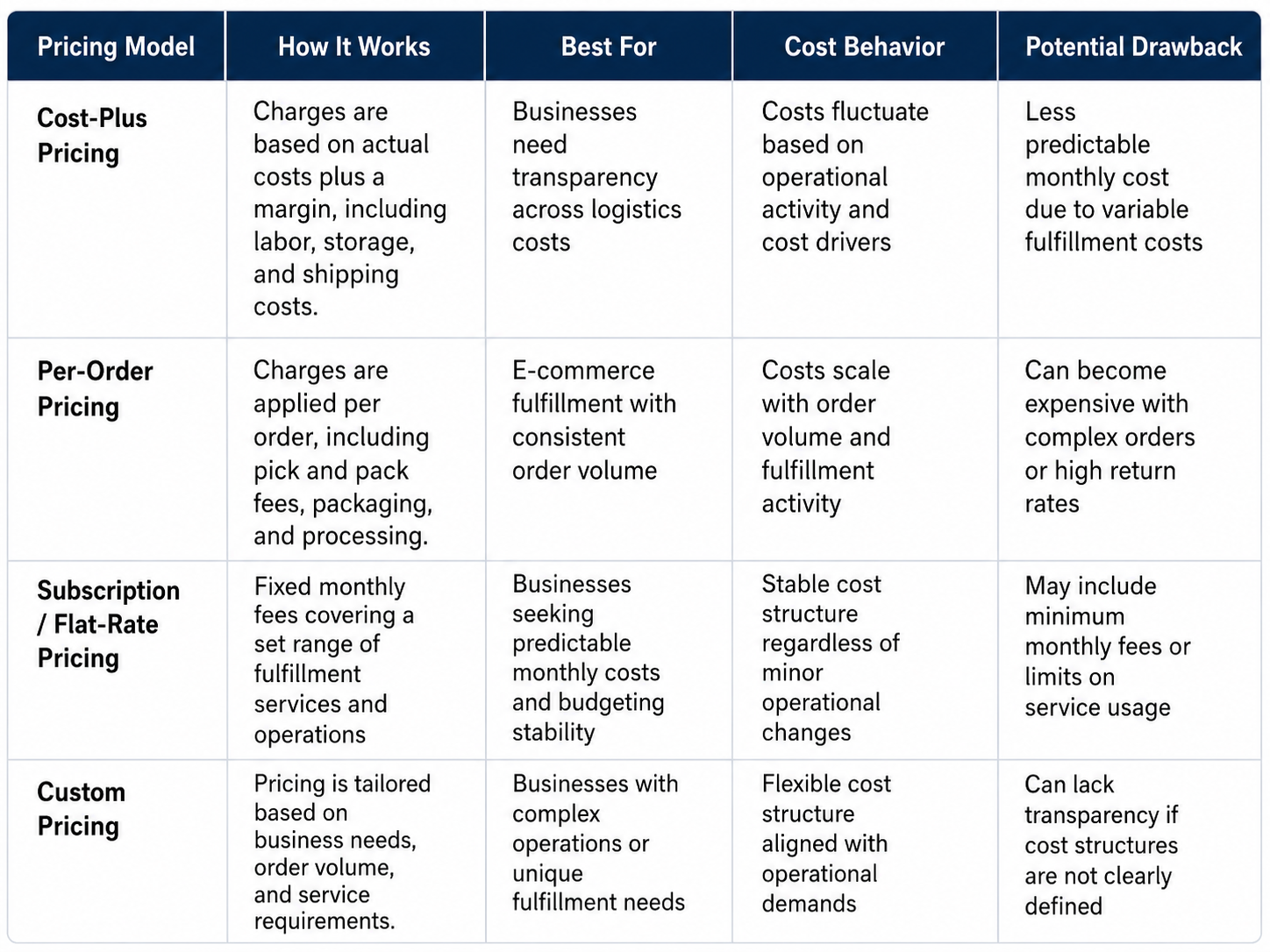
The most effective pricing model often depends on your order volume, fulfillment complexity, and long-term growth strategy. Choosing the lowest upfront cost does not always lead to the best long-term operational performance.
How Do 3PL Pricing Models Work?

3PL pricing models determine how fulfillment providers structure costs across storage, handling, and shipping operations. These models vary based on order volume, service complexity, and operational efficiency. Some pricing structures offer predictable costs, while others fluctuate based on activity and usage. In our experience, choosing the right model depends on how well it aligns with how your operations actually run. The C.O.S.T. Framework (Components, Operations, Scale, Transparency) gives us a practical way to evaluate these pricing structures and avoid hidden costs.
Components
We start by breaking down the core cost components that make up fulfillment pricing, including storage fees, pick and pack fees, shipping costs, and value-added services. In our experience, the way these components are structured has a direct impact on total fulfillment costs. Some providers bundle these costs, while others separate them across multiple fee structures. When components are not clearly defined, it becomes harder to calculate true fulfillment costs. We focus on making these elements transparent so businesses can understand exactly what drives their pricing.
Operations
We look closely at how warehouse operations and fulfillment processes are managed because operational efficiency directly affects pricing. Factors such as inventory management, order processing, and warehouse management systems all influence fulfillment costs. We have seen that inefficient operations often lead to higher costs regardless of the pricing model used. According to the U.S. Bureau of Labor Statistics, rising labor and operational costs continue to impact warehousing and logistics pricing. This is why we prioritize operational efficiency when evaluating cost structures.
Scale
We consider how pricing models perform as order volume changes and businesses grow. Higher order volume can improve cost efficiency through better workflows and volume discounts. However, we have also seen that fluctuating demand and seasonal spikes can increase costs if pricing models are not flexible. The ability to scale efficiently is a key factor in controlling long-term fulfillment costs. We always evaluate whether a pricing model can support growth without creating cost instability.
Transparency
We prioritize transparency in pricing structures because it directly affects how well businesses can manage their logistics costs. Some pricing models clearly outline cost drivers, while others bundle fees in ways that reduce visibility. In our experience, lack of transparency is one of the main reasons businesses encounter hidden fees. We focus on ensuring that pricing structures are clear, predictable, and aligned with operational performance. As TJ Hennessy emphasizes, “Clarity in operations leads to control in costs.”
The right pricing model is not just about structure; it is about how well it supports your operations, adapts to growth, and gives you control over total fulfillment costs.
How to Evaluate and Control Fulfillment Costs
Evaluating and controlling fulfillment costs requires more than understanding individual pricing components; it requires a clear view of how everything works together. In our experience, businesses that actively manage their fulfillment process are better positioned to reduce costs and avoid hidden fees. The goal is not to eliminate costs, but to align them with operational efficiency and business performance. This means focusing on cost drivers that have the greatest impact on total fulfillment costs. A structured approach helps ensure that pricing decisions support long-term growth rather than short-term savings.
We typically start by identifying the key cost drivers within a business’s fulfillment operations, including order volume, inventory management, storage space, and shipping patterns. These factors influence how fulfillment providers charge and how costs behave over time. In some cases, improving inventory turnover can reduce storage fees and long-term storage costs significantly. In other cases, optimizing order processing and packaging can lower pick and pack fees and labor costs. The right approach depends on how these variables interact within each business.
Another important step is improving operational efficiency through better systems and processes. We often see that businesses using warehouse management systems and structured workflows achieve better cost control across fulfillment services. Poor inventory management, inconsistent order volume, and inefficient storage practices can increase total fulfillment costs. Addressing these issues helps reduce unnecessary expenses and improve overall performance. This is where operational improvements translate directly into cost savings.
We also focus on evaluating fulfillment providers based on transparency and flexibility in their pricing structures. Businesses should look for partners who clearly define fee structures, explain cost drivers, and provide visibility into logistics costs. In our experience, unclear pricing is one of the main causes of hidden costs and unexpected charges. Choosing a fulfillment partner with clear and predictable pricing helps businesses maintain better financial control. This approach reduces risk and improves long-term cost management.
Ultimately, controlling fulfillment costs depends on making informed decisions that balance cost, efficiency, and service quality. In some cases, investing in better systems or value-added services can improve efficiency and reduce long-term costs. In other cases, simplifying operations may provide better cost control without additional investment. The key is understanding where costs add value and where they create inefficiencies. This allows businesses to manage fulfillment pricing with greater confidence and consistency.
CONCLUSION
3rd party logistics fulfillment pricing is driven by multiple cost components, including setup, inbound, storage, fulfillment, and shipping, all influenced by operational efficiency and order volume. This guide breaks down how these cost drivers work together, highlights the impact of value-added services and hidden costs, and introduces a practical framework for evaluating pricing models. By focusing on what actually drives total fulfillment costs rather than surface-level fees, businesses can make more informed decisions and avoid unexpected expenses. What sets this guide apart is its clear structure, real operational insights, and actionable framework that helps businesses understand not just pricing, but how to control it.
At Brick Dynamics, we help businesses break down fulfillment pricing, identify cost drivers, and align operations for better efficiency and cost control. Connect with our team to build a fulfillment strategy that gives you clarity and long-term performance.
Frequently Asked Questions
Here are quick answers to common questions about 3rd party logistics fulfillment pricing.
What Factors Influence 3rd Party Logistics Fulfillment Pricing?
3PL fulfillment pricing is influenced by factors such as order volume, inventory management, storage space, shipping zones, and value-added services. These elements work together to determine total fulfillment costs across the supply chain.
How Do 3PL Providers Structure Their Pricing Models?
3PL providers structure pricing using different models such as cost plus pricing, per-order pricing, or custom pricing based on business needs. Each model reflects how fulfillment costs are calculated and applied across operations.
What Are Common Hidden Costs In 3PL Fulfillment?
Hidden costs may include long-term storage fees, minimum monthly fees, disposal fees, and unexpected surcharges tied to inefficiencies. Poor inventory management and unclear pricing structures often lead to these additional costs.
How Can Businesses Calculate Total Fulfillment Costs?
Businesses can calculate total fulfillment costs by evaluating all cost components, including storage fees, fulfillment fees, and shipping costs. Understanding cost drivers helps ensure accurate cost estimation and better financial planning.
What Should Businesses Consider When Choosing A 3PL Provider?
Businesses should consider pricing transparency, operational efficiency, scalability, and how well the provider aligns with their fulfillment needs. A reliable fulfillment partner should offer clear cost structures and consistent service performance.