How Long Does Last Mile Carrier Take?
Last-mile delivery can take anywhere from a few hours to 3 or even 10 days, depending on the shipment and destination. Distance, order volume, traffic congestion, and the type of delivery service all affect how quickly an order reaches the customer. For businesses, knowing what to expect makes it easier to plan operations and manage customer expectations.
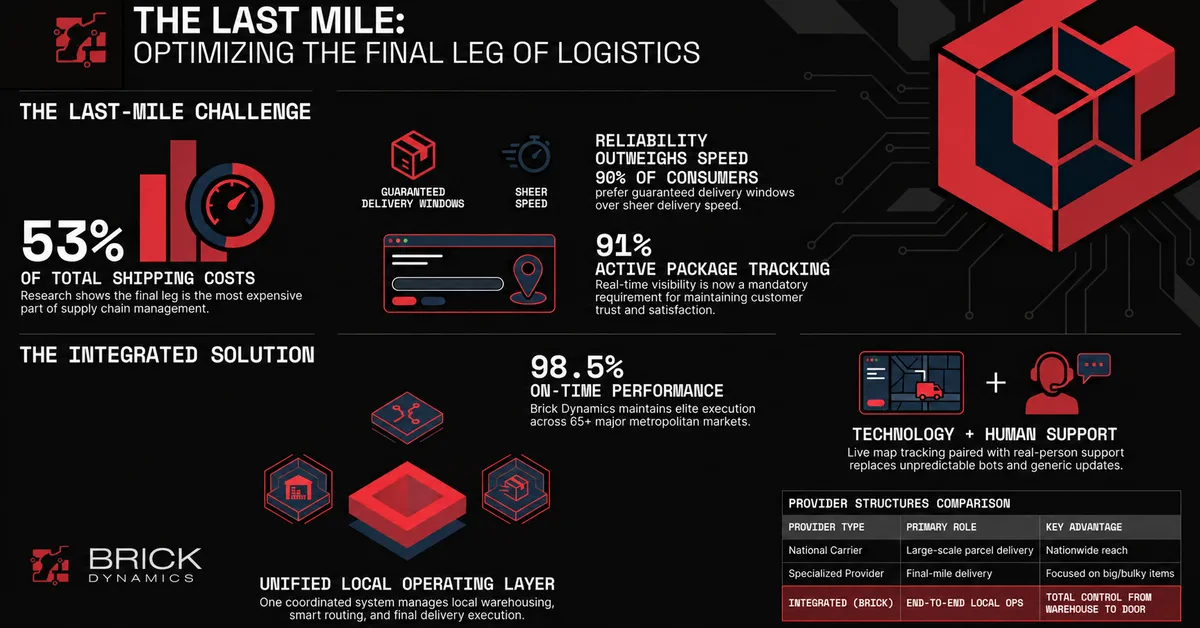
At Brick Dynamics, we have spent the past three years building the local operating infrastructure businesses need to scale across markets. Our network covers over 65+ metros and supports warehousing, logistics, first-mile delivery, last-mile delivery, and reverse logistics through one coordinated system. Our 98.5% on-time performance reflects how important a coordinated local execution layer actually matters. If you need a partner that can support delivery operations across multiple markets, contact us today.
In this article, we will cover what a last-mile carrier is, how long last-mile delivery takes, and the factors that can affect delivery time.
What is a Last Mile Carrier?
A last-mile carrier is the logistics company or fleet responsible for taking shipments from the local warehouse and getting them to the customer’s doorstep. This step covers the shortest distance in the shipping journey but carries the heaviest weight. It is also the most expensive part of the supply chain management system. Industry research from Capgemini and Insider Intelligence puts last-mile costs at as much as 53% of total shipping costs.
This step is critical to running a business because it ties directly to the customer experience, more than any other part of shipping. A late or poorly handled delivery can hurt customer satisfaction even if everything before went perfectly. Customers rarely think about how fast a warehouse picked their order. They notice whether the box arrived on time, in good condition, and at the right door. Reliable last-mile delivery keeps your operations moving efficiently and keeps customers coming back.
Last-mile delivery plays out differently depending on who’s carrying the package. FedEx, UPS, and USPS run massive national networks, built to move volume at scale. Gig platforms like Uber Direct do things differently, focusing on speed with fast, local, same-day drops. Then there are carriers like GoBolt and Locate2U, who skip the usual model entirely and build regional hubs and smarter routing to improve last-mile efficiency within a smaller area.
What Are the Types of Last Mile Carriers?
Several kinds of last-mile carriers serve different purposes. Traditional parcel carriers, like FedEx, UPS, and USPS, handle most daily shipments. Their wide networks are designed for high volume and consistent, nationwide routes.
Specialized last-mile courier services carve out a niche by prioritizing speed rather than scale. Think gig economy platforms and local couriers, who specialize in same-day or even hour-based deliveries in busy urban areas. There is also a newer, growing segment. Companies using drones and autonomous vehicles for deliveries. That work is still mostly in testing and limited markets, but it hints at a future with even faster delivery options.
GoBolt leans toward the traditional model. They combine asset-based fulfillment centers with local delivery, an approach tailored for mid-sized retailers. Their strength lies in owning and managing the physical parts of the last-mile delivery process, which gives them a focused, reliable system.
Brick Dynamics does things differently. Rather than handling just one part of the chain, Brick Dynamics runs the full local operation, covering local warehousing, routing, and last-mile delivery under one system.
Comparing Last-Mile Delivery Options
| Provider Type | Example | Primary Role | Best For | Key Consideration |
|---|---|---|---|---|
| National Carrier | FedEx, UPS, USPS | Large-scale parcel delivery | Nationwide shipping | Less operational control at the local level |
| Specialized Last-mile Provider | GoBolt | Final-mile delivery and customer experience | Brands needing dedicated last-mile services for small to big and bulky items | Coverage may vary by market |
| Delivery Management Platform | Locate2u | Routing, dispatch, tracking, and proof of delivery | Businesses operating their own delivery fleets | Provides technology rather than acting as the carrier |
| Integrated Local Operations Provider | Brick Dynamics | Warehousing, routing, and last-mile execution | Businesses expanding across multiple local markets | Designed for companies needing broader operational support |
How to Choose a Last-Mile Carrier
-
Choosing a last-mile carrier is not just about picking the cheapest or fastest option. Consider service quality, area, and market coverage, because a last-mile logistics carrier far from your customers will still cause delays. Then look at delivery speed and the service levels available, whether that is same-day delivery, next-day delivery, or standard ground.
-
Ask for real numbers because on-time performance matters more than a marketing promise. Real-time tracking and proof of delivery are now expected, rather than optional. Customers want to see where their package is at each time and get confirmation once it arrives.
-
A few other things matter just as much, even if they are less obvious. Check how a carrier handles returns, because that process shapes customer experience almost as much as delivery does. Warehousing capabilities matter too, especially if you’re managing inventory across multiple locations.
-
Always think ahead. Make sure your carrier can expand with you as your business grows into new markets. When issues pop up, real human support counts for a lot. Do not settle for bot responses, because they can negatively impact customer experience. And do not forget to see how smoothly the carrier connects with your current systems. Even the best carrier on paper will not help if it does not fit the way you work.
What Are the Factors that Affect Last Mile Delivery?
Different services have different timelines. Same-day and gig-based delivery can arrive within hours, while standard carriers usually average two to five business days for most shipments. A couple of factors influence this range.
One factor is the location and how far the shipment has to travel to reach the customer. The closer you are to the local hub, the faster your package will arrive. Traffic and weather matter just as much, sometimes more. A storm can shut down an efficient route for an entire day or longer.
The number of packages also factors in, since a driver with forty stops will inevitably move slower than one with fifteen. Smart route planning helps drivers manage it, though it does not erase the problem completely. Urban and rural areas play out differently here. Cities often have shorter distances but heavier traffic to fight through. Rural areas cover more ground with fewer trucks running the route. That is why a small-town delivery can take twice as long as a city one.
Better tools can improve delivery time. Modern routing software can adjust a driver’s path in real time by factoring in live traffic and new orders as they come in. Real-time tracking gives customers a much clearer picture of when their package will arrive. Carriers investing in this kind of technology tend to have more reliable delivery times, which makes customer expectations easier to manage.
What Are the Common Reasons for Delivery Delays?
No one wants to wait longer than they should for a shipment. These delays can be genuinely annoying, especially when you are not sure why they’re happening. Sometimes it comes down to incomplete or incorrect addresses. A missing apartment number or a small typo can send your package to the wrong place entirely. To avoid that headache, always double-check your address at checkout before you finalize the order.
Another common reason for delay is failed delivery attempts. If you are not home to sign for your package, it gets sent back to the depot, which means another day of waiting. Pick a delivery window when you know you will be around to avoid the hassle.
Some delays are simply beyond anyone’s control. An unexpected roadblock can shut down an entire route, and rerouting becomes the only option. Peak-season backlogs can also cause delays. When order volume outpaces staffing, packages queue up faster than routes can clear them. So if you’re shipping during a busy period, you may need to wait a few extra days.
How Can You Optimize Last Mile Delivery with Technology?
Technology has slowly become an important part of reliable last-mile delivery. A few years ago, deliveries relied on fixed plans and paper manifests. That approach is fading fast, replaced by tools that adjust in real time.
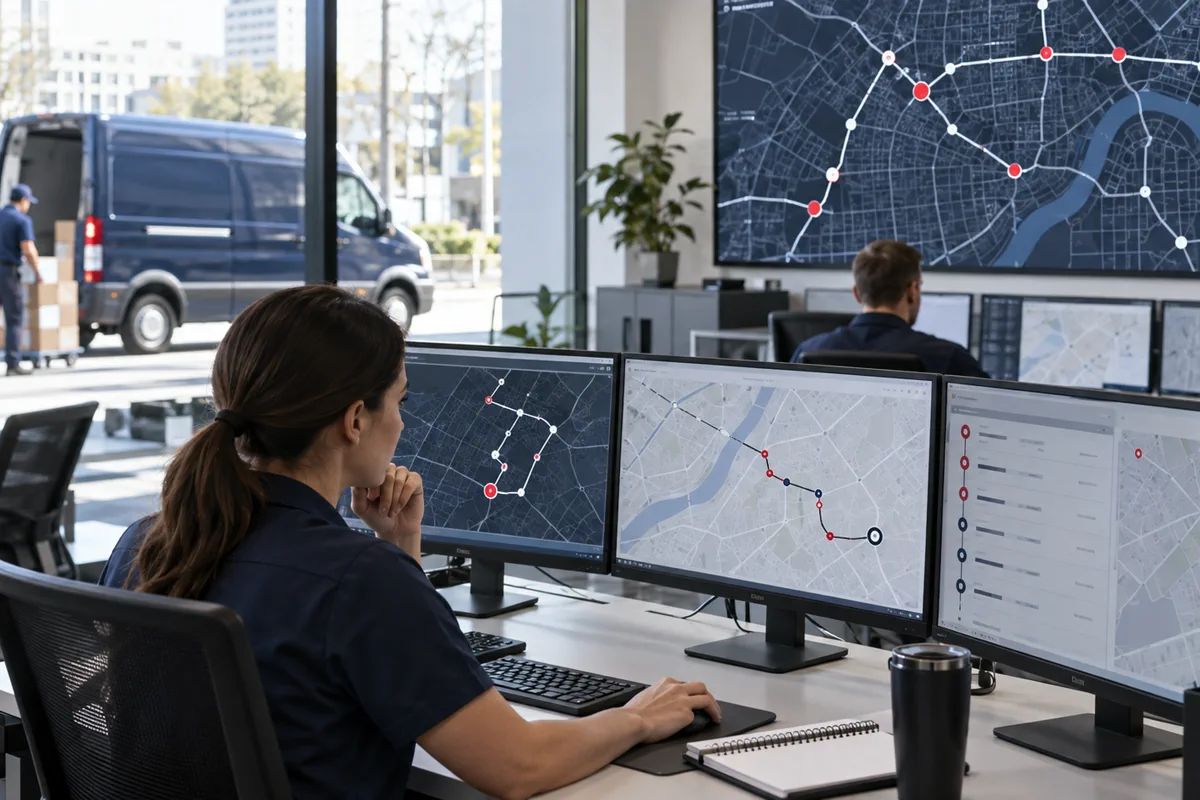
AI and machine learning now handle much of that shift. Routing software recalculates a driver’s path as traffic, weather, and new orders come in throughout the day. That flexibility shaves real minutes off every stop, which adds up fast across a full route.
IoT devices are also making delivery tracking smarter and more transparent. With sensors on delivery vehicles, carriers and customers get real-time updates on exactly where a package is. That familiar “your driver is 4 stops away” message is usually IoT in action.
It might seem like a minor upgrade, but it genuinely helps people organize their day around a delivery. Technology cannot replace skilled drivers or thoughtful planning, of course, but it does make both better. Companies that invest in these tools tend to deliver within tighter, more reliable time windows.
How to Track a Last-Mile Carrier Shipment
-
Last-mile carrier tracking should not feel like guesswork. Most carriers send a tracking link as soon as your package ships, so start there. That link opens an online portal showing the shipment’s current stage, from pickup to delivery.
-
Mobile apps take it a step further. They send notifications the moment your delivery status changes, so you don’t have to keep refreshing a page. Some apps even show a live map of your driver’s location, with an ETA window that narrows as they get closer.
-
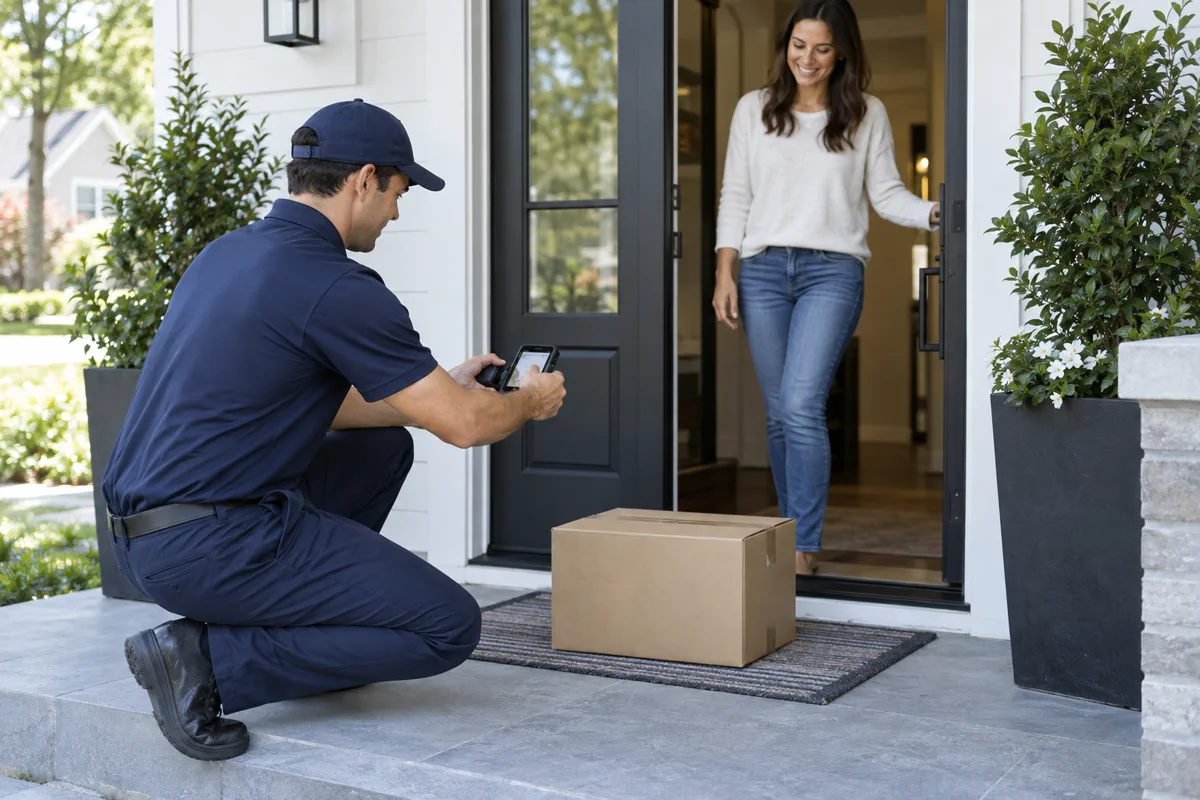
This kind of visibility does more than satisfy curiosity. Recent research from Business Wire found that 91% of consumers actively track their packages, which is exactly why clear tracking matters so much to the overall customer experience. Clear tracking reduces anxious waiting and the constant calls to drivers to find out where a package is. It also provides proof of delivery, like a timestamped photo, once your package arrives.
-
It’s not even about speed. According to McKinsey, 90% of consumers prefer guaranteed delivery windows over speed. For businesses, that transparency builds trust and takes pressure off support teams. A good delivery experience matters because it turns an unpredictable wait into something you can plan for.
How Does Brick Dynamics Ensure Fast and Efficient Last Mile Carrier Services?
Fast, reliable last-mile delivery does not happen by accident. It results from many moving parts working together. At Brick Dynamics, we make this possible by building tight networks and optimizing our local routes. Our real-time tracking gives you more than a generic “arriving today” message.
You get to see your driver’s location on a live map and get a clear ETA window that updates as the driver gets closer. And if something unexpected happens, you will not be stuck talking with bots. You get to communicate with a real person who is ready to meet your needs.
This efficiency is evident in the work we did with Stack. With our help, Stack, a company renting eco-friendly moving bins, scaled to 65+ markets and $3M+ in first-year revenue with a team of just two people. They did it without building local infrastructure themselves, leaning entirely on Brick Dynamics to handle warehousing, routing, and delivery. Growth like that only works when the delivery side never becomes the problem. It proves that fast, dependable last-mile service isn’t just a nice feature. It is what allows a small team to compete at a much bigger scale.
Compared to competitors, the difference usually comes down to structure. Many carriers specialize in just one piece of the process, whether that’s routing software or asset-based delivery. Brick Dynamics runs the full local operating layer instead.
That means fewer handoffs, fewer places for things to go wrong, and more consistency across markets. Timely arrivals and satisfied customers are not separate goals. They are the same result, built from the same reliable process, repeated at scale.
Why Does Your Last Mile Carrier Choice Matter?
Your final mile carrier choice shapes almost everything about how a delivery goes. It is the final leg of delivery, and it affects how fast a package arrives, how easily you can track it, and how smoothly delays get handled when they happen. Distance, traffic, and weather all play a role, but the right carrier can handle them.
Last-mile logistics companies with tight routes and real-time tracking turn unpredictable wait times into something you can actually plan around. That is the difference between a simple delivery and one that prioritizes customer satisfaction.
At Brick Dynamics, we’ve built our entire network around that kind of consistency, not just speed. Our 98.5% on-time rate across 65+ metros is not an accident. It comes from running warehousing, routing, and last-mile delivery under one reliable system. If you are ready for delivery you can actually count on, reach out to us and let us figure out how to improve your operations.
Frequently Asked Questions
Do you still have questions about last-mile carriers? Below are answers to some of the most common questions we usually come across.
What is a Last-Mile Carrier?
A last-mile carrier is the company responsible for moving your package to the final destination. They move your package from a local warehouse directly to the customer’s door.
How Long Does a Last Mile Carrier Take to Deliver Packages?
Most deliveries take between one and five, or up to ten, business days, depending on the carrier. Same-day or gig-based delivery can arrive in hours, while rural or international shipments can take up to ten days.
What Are Some Common Factors That Can Affect the Delivery Time of a Last Mile Carrier?
Delivery location, traffic, weather, and order volume can all affect your last-mile delivery timeline. Address accuracy, missed delivery windows, and recipient availability also matter, since one missed attempt can add a full extra day.
Can I Track the Progress of My Package With the Last Mile Carrier?
Yes. Most carriers provide online tracking portals and mobile app notifications that show your package’s status and a live ETA window.
How Can I Ensure Smooth, Timely Delivery With a Last Mile Carrier?
Double-check your shipping address before checkout and pick a delivery window you’ll actually be available for. If you’re shipping during a busy season, build in a few extra days, just in case.